Virtual Greyhound Racing Betting
Best Greyhound Betting Sites – Bet on Greyhounds in 2026
Loading...
Virtual Dogs: What You’re Actually Betting On
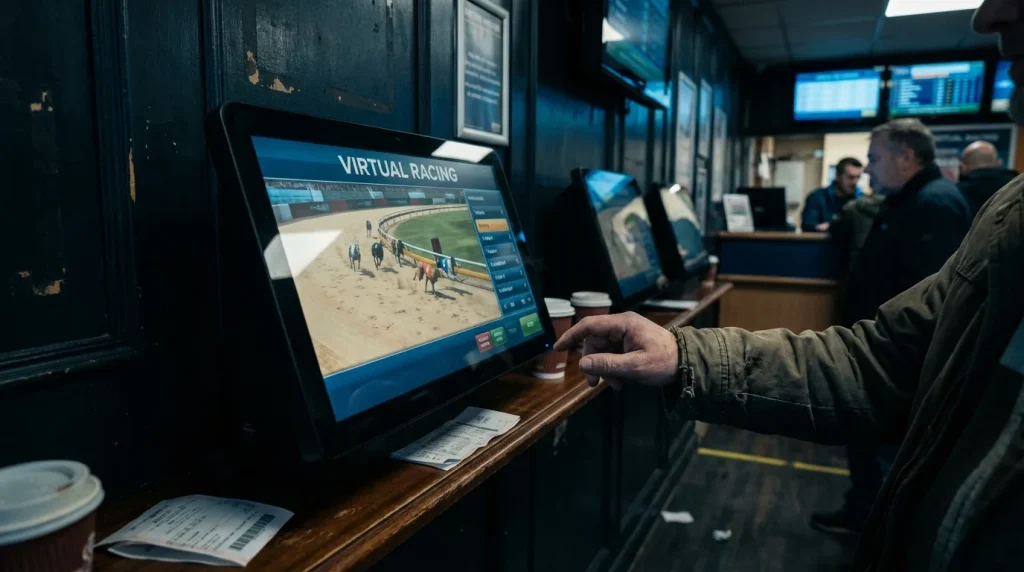
Virtual greyhound racing looks like dog racing, sounds like dog racing, and has odds like dog racing. It is none of those things. The animated dogs on your screen are cosmetic illustrations of a mathematical process that was complete before the race began. There are no real dogs, no real form, no real draw dynamics, and no real skill involved in predicting the outcome. Virtual greyhound racing is a random number generator dressed in a racing jacket, and understanding that distinction is essential before you place a single pound on it.
That’s not necessarily an argument against ever betting on virtuals — it’s an argument for knowing exactly what you’re doing when you do. Virtual racing is a gambling product, not a betting product. The difference matters. Betting implies that skill, analysis and information can influence your returns. Gambling implies that the outcome is determined by chance and the house holds a fixed mathematical edge. Virtual greyhounds sit firmly in the second category, and treating them as the first is the fastest way to erode a bankroll.
How Virtual Greyhound Racing Works
The technical process behind virtual racing is a random number generator. Before the animation plays, the RNG determines the finishing order. The race you watch is a pre-rendered visualisation of a result that already exists — the animation adds drama, but it has no bearing on the outcome. The dogs don’t “run” in any meaningful sense. Their positions are assigned, and the graphics illustrate those positions in a way that mimics the look and feel of real racing.
Odds in virtual greyhound racing are set by the software provider, not by a market. There are no bookmakers pricing individual runners based on form, no punters creating supply and demand, and no market forces adjusting the prices before the off. The odds are mathematically determined to produce a specific house edge — typically between 15% and 25%, depending on the product and the bet type. This edge is fixed and non-negotiable. No amount of analysis can reduce it, because there is nothing to analyse.
Virtual races cycle rapidly — a new race starts every two to four minutes, depending on the provider. The major suppliers (Inspired Entertainment, Kiron Interactive) produce virtual greyhound products that are distributed through bookmakers’ websites and betting shop screens. Each provider uses its own RNG algorithms and animation styles, but the underlying principle is identical: random outcomes, fixed margins, continuous availability.
Available Markets on Virtual Dogs
Virtual greyhound platforms offer win, forecast and tricast markets — the same names as real greyhound markets, but with fundamentally different underlying probability. In real racing, a forecast is difficult because you’re predicting the behaviour of living animals affected by draw, running style, conditions and interference. In virtual racing, a forecast is difficult because you’re predicting the output of a random number sequence. The bet names are familiar. The skill requirement is zero.
Win bets on virtuals work identically to any fixed-odds bet: pick a dog, place a stake, and if the RNG assigns it first place, you win at the quoted odds. The odds on each virtual runner reflect its assigned probability within the algorithm, and those probabilities are calibrated to sum to more than 100% — the overround, which guarantees the house its margin on every race.
Forecast and tricast bets carry higher payouts, just as they do in real racing, but the probability of landing them is governed entirely by the number of possible combinations. In a six-runner virtual race, there are 30 possible forecast combinations and 120 tricast combinations. The odds on these bets are set to deliver the house edge across all outcomes, and over any meaningful sample of bets, the return to the punter will converge on a figure below 100% of the total staked.
Some virtual platforms also offer accumulator markets across consecutive virtual races. These compound the house edge with every added leg, just as they do in real-race accumulators, but without any skill component to offset the mathematical disadvantage. A virtual greyhound accumulator is the purest form of negative-expectation gambling available on a bookmaker’s platform — the house edge multiplies across legs with no countervailing analysis to reduce it.
Virtual vs Real Greyhound Racing: Key Differences
The differences are not subtle. Real greyhound racing involves living animals with individual characteristics, trained by professionals, racing on sand tracks affected by weather, from starting positions that influence the outcome. Every piece of information — form, draw, grade, conditions, trainer, sectional times — is a potential edge for the informed bettor. The market is imperfect, and the imperfections create value opportunities.
Virtual racing has none of these features. There is no form because there is no continuity between races — each virtual event is an independent random process with no connection to any previous one. There is no draw bias because the trap positions carry no physical meaning. There are no conditions, no trainers, no injuries, no running styles. The only consistent element is the house edge, and it works against you on every bet.
The critical distinction for punters is this: in real racing, a skilled bettor can achieve a positive expected value over time. In virtual racing, no bettor can achieve positive expected value, regardless of their approach. The maths is locked. Every virtual bet has a negative expectation built into it, and that expectation doesn’t change with strategy, experience, or pattern recognition — because the patterns don’t exist.
Is Virtual Greyhound Betting Worth Your Stake?
Virtual racing fills the gaps between real cards. Whether that’s a benefit or a risk depends entirely on your discipline. At 2am, when no real racing is running and the urge to bet is strong, virtual dogs are available. At lunchtime, when the first BAGS meeting is an hour away, virtual races are cycling on the screen. The product is designed for availability, and availability is the friend of impulse betting.
If you treat virtual greyhounds as entertainment — a fixed-cost leisure activity with a set budget, like a slot machine or a lottery ticket — there’s nothing wrong with it. You’re paying for the experience of watching a race and having a stake on the outcome. The expected loss is the price of that experience, and if you’ve budgeted for it, no harm is done.
The problem arises when virtual racing becomes a substitute for real betting. When you find yourself applying form-reading instincts to virtual dogs, or developing “systems” based on trap numbers or colour patterns, you’ve crossed from entertainment into delusion. Virtual results are random. Any pattern you perceive is noise, not signal. Betting more after a losing streak (chasing) or increasing stakes because you’re “due a winner” (gambler’s fallacy) will accelerate your losses.
The honest assessment: virtual greyhound racing is a negative-expectation game that offers entertainment value and nothing else. Budget accordingly, or avoid it entirely.
Virtual Reality: Entertainment, Not Investment
If you bet on virtual dogs for the same reasons you bet on real dogs, you’re applying a toolkit to a problem it wasn’t built for. The skills that make you profitable in real greyhound racing — form reading, draw analysis, understanding conditions and grades — have no application in the virtual arena. Save those skills for the races where they matter. If you want to bet on virtuals, bet small, bet rarely, and never pretend it’s anything other than what it is: a random number generator with an animation on top.