UK Dog Racing Betting
 Available in US
The complete guide to greyhound wagering — odds, form, strategy, and every bet type explained for UK punters.
Contents
What Makes Greyhound Betting Different From Every Other Sport
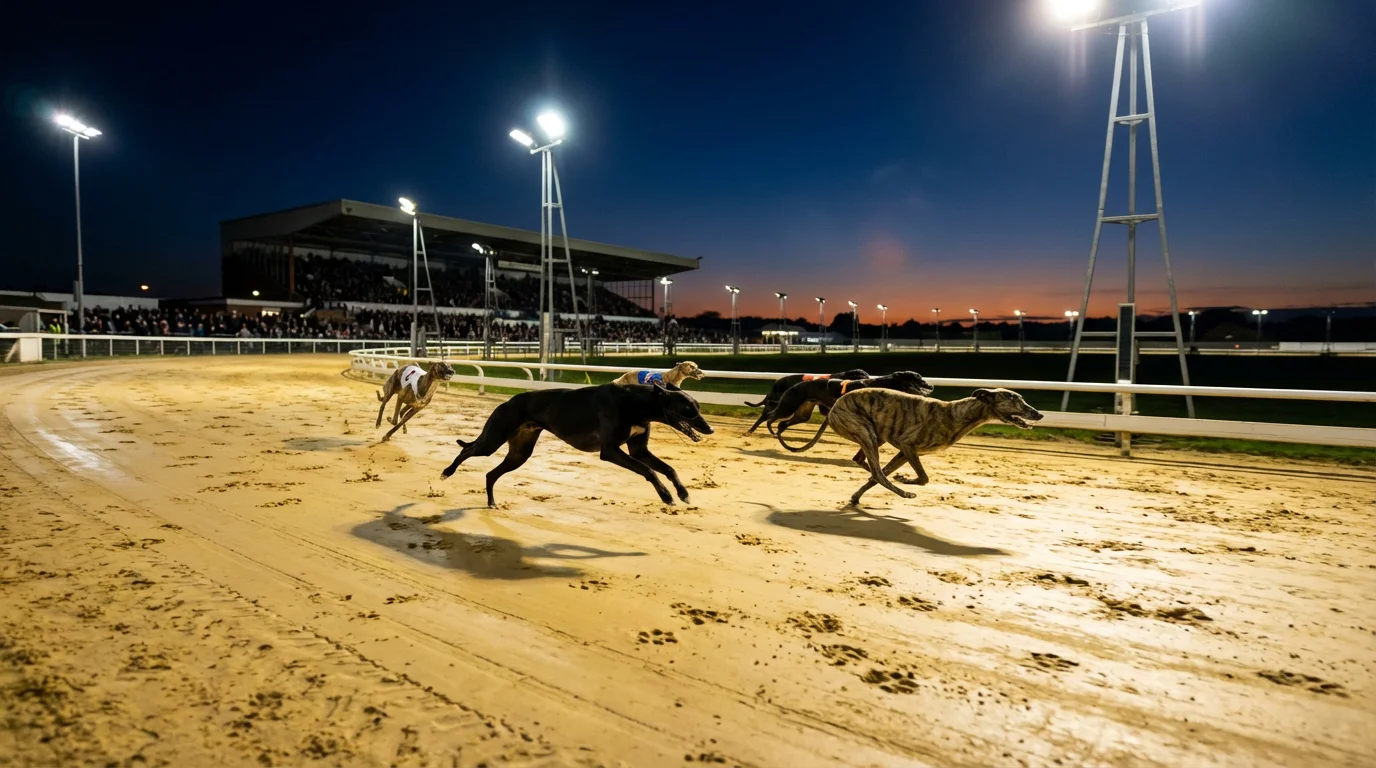
Six dogs, thirty seconds, no jockey — greyhound racing strips betting down to its mechanical core. There is no rider to read, no formation to dissect, no half-time substitution to recalculate. A race starts, the traps open, six greyhounds chase a mechanical hare around an oval of sand, and inside half a minute one of them crosses the line first. That compression changes everything about how you bet.
Where horse racing demands you weigh a jockey's form, the going, draw bias, and trainer intent across fields of a dozen runners, greyhound betting narrows the variables. Six runners. Races every fifteen minutes. And a form card that, once you learn to read it, tells you almost everything the odds are trying to hide. UK dog racing betting rewards a particular kind of punter: the one who studies the draw, understands grading, and spots the small shifts in time and trap history that separate a genuine contender from a well-backed name.
UK dog racing betting covers all wagering on licensed greyhound racing events in Great Britain, regulated by the Greyhound Board of Great Britain. It includes on-course betting at the track, off-course wagers through licensed bookmakers, and online markets offered by regulated operators. Races take place on sand tracks at GBGB-licensed stadiums, with fields of six graded greyhounds competing over standard, sprint, or staying distances.
This guide works through every layer of greyhound betting as it operates in 2026: the mechanics of a race, the full range of bet types, how to decode the form card, why trap draws matter more than raw speed, and the strategic framework that turns an occasional punt into a structured approach.
How a Greyhound Race Works
Before you back a dog, you need to understand what happens between the traps opening and the hare stopping. Greyhound racing in Britain follows a standardised format across all eighteen GBGB-licensed stadiums, though track dimensions and distances vary. The essentials are constant: six greyhounds, numbered and jacketed by trap, chase a mechanical lure around a sand-surfaced oval circuit.
Every runner wears a coloured jacket corresponding to its
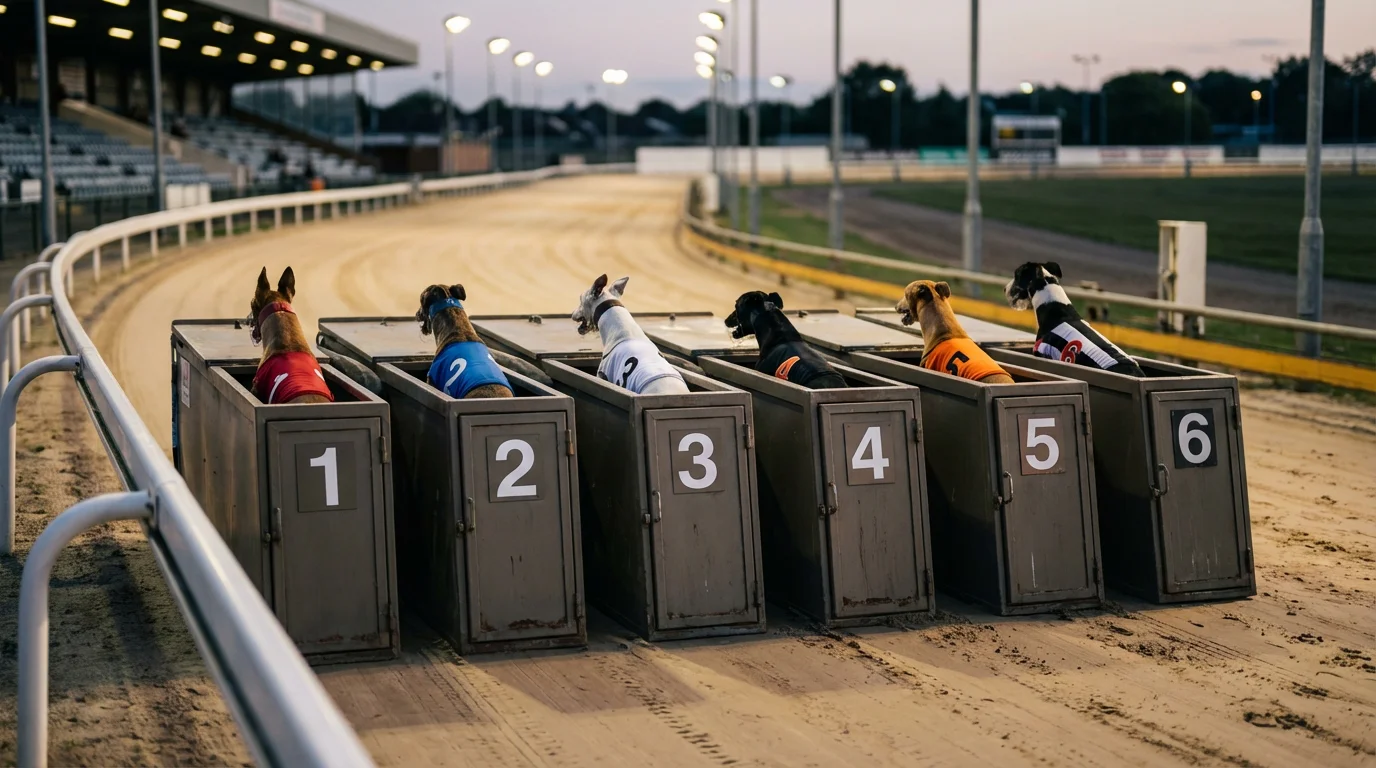
trap — the numbered starting box (1–6) from which a greyhound begins the race, positioned on the inside rail (trap 1) through to the outside (trap 6).
lure — an artificial hare mounted on a rail that runs around the outside of the track, set at a speed the dogs can chase but never catch.
graded race — a competition in which greyhounds are grouped by ability level (A1 being the highest standard of graded racing, down to A10 at some tracks), ensuring competitive fields of similar quality.
system that ensures competitive balance — dogs of similar ability race against each other, with upgrades and downgrades triggered by performance.
Standard races cover four bends of the oval, with distances typically ranging from 400 to 500 metres depending on the circuit. Sprint races are shorter — two bends, around 260 metres — and stayers' events stretch beyond 600 metres, sometimes over six or even eight bends. The distance matters enormously for betting: a dog that dominates over four bends may have no stamina for six, and a strong closer needs enough track to overhaul the front-runners.
Traps, Colours and the Starting Procedure
The six traps are colour-coded and the system is universal across all GBGB tracks: trap 1 is red, trap 2 blue, trap 3 white, trap 4 black, trap 5 orange, and trap 6 striped (black and white). These colours appear on the racing jackets and on every racecard, so even from a distance, spectators can follow each dog's position through the race.
Before the off, greyhounds are loaded into the starting boxes by kennel hands under the supervision of the starter. The dogs are placed in trap order, and once all six are loaded, the starter triggers the mechanical hare and then the trap mechanism. The lids of all six traps fly open simultaneously. If a dog is slow to leave — what the form card records as "slow away" or "baulked at traps" — it can lose two or three lengths before the first bend, which in a thirty-second race is often unrecoverable. In tight finishes, a photo-finish camera mounted on the winning line determines the result, with distances between dogs recorded in lengths or short heads.
Race Structure: Bends, Straights and the Run-In
A standard four-bend race divides into distinct phases. The break from the traps and the run to the first bend is where position is established — and where most races are effectively decided. Dogs on the inside line (traps 1 and 2) have less ground to cover into the first bend but risk crowding. Dogs drawn wide (traps 5 and 6) have more room but must cover extra distance unless they possess the early speed to cross the field.
Through the bends, the racing line matters. A dog that rails — hugs the inside — saves ground on every turn. A dog that runs wide surrenders lengths but avoids traffic. The straights are where raw speed shows: a greyhound with strong late pace can close gaps on the back straight or the run-in, the final stretch from the last bend to the finishing line. The run-in varies by track, from as short as fifty metres at some tighter circuits to well over a hundred at Towcester, and this difference alone can change the value of a front-runner versus a closer.
Greyhound Bet Types at a Glance
Every greyhound market exists for a reason — and most punters never get past the first two. The win bet is where the majority of money goes, followed by each-way, and the rest of the menu sits largely untouched. That is a missed opportunity. Forecasts, tricasts, and speciality markets serve specific purposes, and understanding when to use them matters as much as picking the right dog.
Win
Back a dog to finish first. The simplest greyhound bet — one selection, one outcome. If your dog wins, you collect; if it does not, you lose your stake.
Each-Way
Two bets in one: a win bet and a place bet. If your dog wins, both parts pay. If it finishes in the places (usually first or second), you collect the place portion at reduced odds.
Forecast
Predict the first two dogs home. A straight forecast requires the exact order; a reverse forecast covers both permutations at double the stake.
Tricast
Predict the first three dogs in exact finishing order. High difficulty, high dividends — a single correct tricast can return fifty or a hundred times your stake.
Accumulator
Link two or more selections across different races. The returns multiply with each winner, but one loser collapses the entire bet.
Speciality
Markets like trap challenge (backing a trap number across multiple races), inside vs outside, or winning distance. Available primarily through online bookmakers.
The choice of bet type should follow from your analysis, not precede it. A race where you have strong opinions on two dogs but cannot separate them calls for a forecast. A race where you fancy a dog at big odds but worry about consistency is an each-way situation. Matching the market to the race is a skill in itself, and the sections below break down how each type works in practice.
Win and Place Bets: The Foundation
A win bet requires your selection to finish first. No margin, no consolation — second place pays nothing. In a six-dog field, the raw probability of any single runner winning is roughly 16.7%, though actual chances vary enormously by form, draw, and grade. The gap between what the market thinks and what the data suggests is where profitable betting lives.
The place bet pays if your dog finishes in the first two in a standard six-runner race. Place odds are typically a quarter or a fifth of the win price, but the strike rate is significantly higher. Note the field size: with only six runners, place terms are tighter than in horse racing, where eight or more runners usually trigger three places.
One decision every greyhound punter must make is whether to take an early price or wait for the starting price. Early prices, available from the morning, reflect the bookmaker's opening assessment. The SP is fixed at the off and reflects late market movements. In greyhound racing, late money can shift odds dramatically in the final minutes.
Each-Way Greyhound Bets: When They Work
Each-way betting on greyhounds is one of the most commonly used and most commonly misunderstood bet types. An each-way bet is two separate bets: one on the dog to win, and one on the dog to place. If the dog wins, both bets pay. If it places but does not win, only the place part pays — at a fraction of the win odds.
Standard each-way terms for greyhound racing are 1/4 odds for places 1–2. A £5 each-way bet at 8/1 costs £10 total (£5 win, £5 place). If the dog wins, you collect on both parts. If it places second, you lose the win stake but receive the place payout. The break-even price for an each-way bet in a six-runner field with 1/4 odds on two places sits around 4/1.
Each-Way Bet: 5/1, £5 stake
Total outlay: £10 (£5 win + £5 place)
Place terms: 1/4 odds, places 1–2
If dog wins: £30 (win return) + £11.25 (place return at 5/4) = £41.25 return
If dog places 2nd: £0 (win) + £11.25 (place return at 5/4) = £11.25 return
If dog finishes 3rd–6th: £0 return, £10 lost
The trap that most each-way punters fall into is backing short-priced dogs each-way. At 2/1, an each-way bet is almost always poor value in a six-dog race: the place return barely covers the combined stake, and you would be better off simply backing the dog to win at the full price. Each-way betting works best at odds of 5/1 and above, where the place safety net provides meaningful protection without crippling the potential return.
Forecasts and Tricasts: Predicting the Order
Forecasts and tricasts are where greyhound betting rewards genuine analysis. A straight forecast requires you to name the first two dogs home in the correct order. A reverse forecast covers both possible orders at twice the stake. Combination forecasts extend the principle: select three or more dogs and the bet covers every possible first-and-second pairing, with costs escalating quickly.
Forecast dividends fluctuate widely. A forecast involving two short-priced runners might return 5/1 or less. A forecast pairing two outsiders can return 50/1, 100/1, or more. The payout depends on the combined odds of the placed dogs, not a fixed formula.
Tricasts demand even more precision: name the first three home in exact order. In a six-dog race, there are 120 possible permutations. A combination tricast covering all permutations of three selected dogs costs six units; select four dogs and the cost rises to twenty-four. Disciplined punters limit tricast selections to races where the form strongly narrows the field — ideally three or four genuine contenders with the rest clearly outclassed.
Reading the Greyhound Form Guide
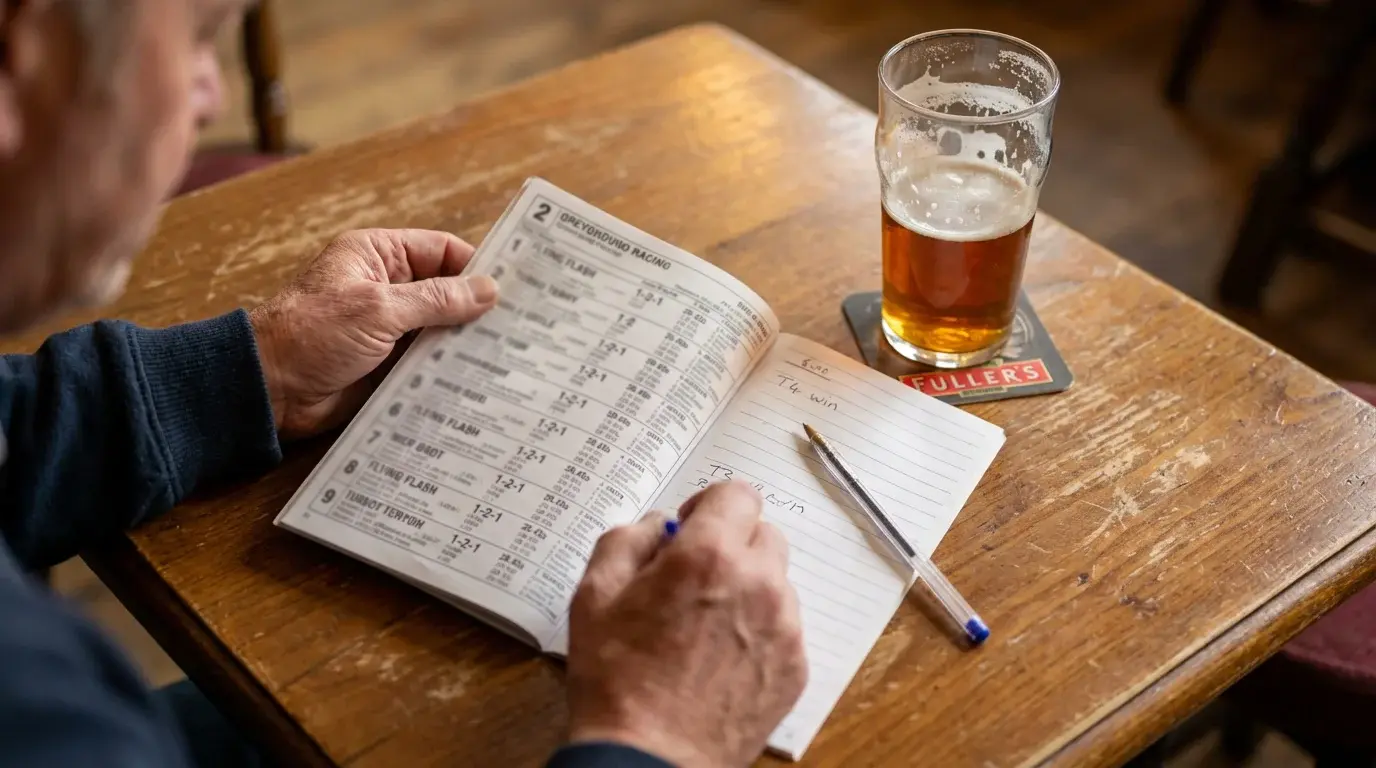
A greyhound form card looks like encrypted noise until you know which columns actually matter. Every race card published for a GBGB meeting lists the same core data for each of the six runners: trap number, dog name, trainer, form figures, finishing times, race comments, weight, and sectional or calculated times where available. The art is in knowing what to prioritise and what to skip.
Most casual punters look at the form figures — the sequence of finishing positions from recent races — and stop there. A dog showing 1-1-2-1 looks like a banker. But those figures tell you nothing about the grade it ran in, the trap it was drawn in, the quality of opposition it faced, or whether it was flattered by the draw. Form without context is a trap of its own, and the experienced greyhound punter treats the headline figures as a starting point, not a conclusion.
Form Figures
Recent finishing positions (e.g. 1-3-2-1). Shows consistency but not context — always check grade and trap.
Times
Finishing time and sectional splits. Compare calculated times, not raw times, to assess true speed across different tracks.
Comments
Race narrative in shorthand. Codes like "Ld1" (led from trap 1), "Bmp1" (bumped at bend 1), "RnOn" (ran on) describe what actually happened.
The three pillars of greyhound form analysis — figures, times, and comments — work together. A dog that shows a poor finishing position but was badly baulked at the first bend (the comments will tell you) and still clocked a competitive time may actually be in better form than a dog that won unchallenged in a weak grade. Learning to read form in layers, not at face value, is the single most important skill in greyhound betting.
What Each Column on the Racecard Means
A typical greyhound racecard line reads left to right and contains: trap number, dog name, trainer name, sire and dam (sometimes abbreviated), form figures for the last six runs, best recent time, grade of previous race, weight, and race comments. Some cards also include sectional time data, forecast odds, and a star rating or selection marker from the card compiler.
Take a sample line: 3 BALLYMAC STELLA (W) 29.86 A3 27.2kg with form 2-1-4-1-3-2 and comment "EP,Ld2-Bmp3,RnOn". The trap number (3, white jacket) tells you the starting position. The "(W)" indicates a wide runner. The time 29.86 is the best recent finishing time. A3 is the grade. 27.2kg is the racing weight. The form figures show mixed recent results. And the comment decodes the last race: showed early pace, led at bend two, was bumped at bend three, and ran on to the line. From that single line, you can already start building a picture — this is a dog with speed but one that encountered trouble in traffic.
The columns most punters overlook are weight and running style tag (R for railer, M for middle, W for wide). Weight fluctuations of more than half a kilogram between runs can signal illness or fitness changes. The running style tag connects directly to the draw: a wide runner drawn in trap 1 faces a problem that no amount of ability can overcome.
Sectional Times and Adjusted Race Times
Raw finishing times are the most misleading statistic on the racecard. A time of 29.50 at Romford over 400 metres and 29.50 at Nottingham over 480 metres are not comparable, and even at the same track, times vary with sand depth, weather, and running rail position. This is why serious form students use calculated times — times adjusted for track variance, going, and race dynamics — rather than the headline figure.
Calculated times aim to standardise performance. Services like Timeform and specialist greyhound data providers apply corrections for track speed, wind, and moisture to produce a figure that allows cross-track comparison. A dog with a calculated time of 29.20 at a slow-running track may be faster in real terms than one clocking 28.80 at a naturally quick circuit. If you are comparing two dogs that have not raced at the same venue, calculated times are the only reliable metric.
Sectional times break the race into phases: the run to the first bend (early pace), the middle section, and the run-in (finishing speed). A dog with a fast first sectional but a fading late split is a front-runner — valuable from a good draw, vulnerable from a bad one. A dog with a slow split early but a rapid closing section is a closer, needing a long run-in to deliver. Where sectional data is available, it adds a dimension that headline times cannot provide.
Trap Draw: Why Starting Position Decides Races
The draw wins more greyhound races than raw speed — and most casual punters never check it. In horse racing, the starting stall is one factor among many. In greyhound racing, the trap is often the decisive factor, because the run to the first bend is so short that positional advantage or disadvantage is locked in before the dogs have covered a hundred metres.
The principle behind greyhound draw analysis is straightforward. Racing managers seed the traps based on each dog's known running style: railers are placed on the inside (traps 1 and 2), middle runners in the centre (traps 3 and 4), and wide runners on the outside (traps 5 and 6). When the seeding works — when every dog gets its preferred position — the race flows cleanly. When it breaks down, when a railer is drawn wide or a wide runner finds itself on the inside with nowhere to go, the result can be chaotic. Those mismatches are where the shrewd punter finds an edge.
Trap 1 — Inside Rail
Shortest run to the first bend. Favours confirmed railers with early pace. Vulnerable if the dog breaks slowly: traffic from traps 2–3 can squeeze it against the rail. Statistically the most successful trap at most UK circuits.
Trap 6 — Wide Outside
Longest run to the first bend. Suits wide runners with strong early speed — they have room to stride and avoid crowding. Disadvantaged by the extra ground to cover. Works best at tracks with long run-ups to the first bend. Can be a liability on tight circuits.
Every track has its own trap bias. At some venues, trap 1 dominates over sprint distances because the first bend comes so quickly that inside position is almost insurmountable. At others, traps 5 and 6 thrive over standard trips because the run-up is long enough for a wide runner to establish position before the turn. Track-specific trap data is published by several specialist websites and is essential homework for any regular greyhound punter.
The sharpest betting angle in the draw is the mismatch: a well-fancied dog drawn in the wrong trap for its running style. A favourite that rails naturally but has been assigned trap 5 faces more crowding than the market price acknowledges. Conversely, a lower-fancied dog that draws its ideal trap against badly drawn rivals can represent genuine overlay value. Opposing badly drawn favourites and backing well-drawn outsiders is not a system, but it is a discipline that improves your long-term returns.
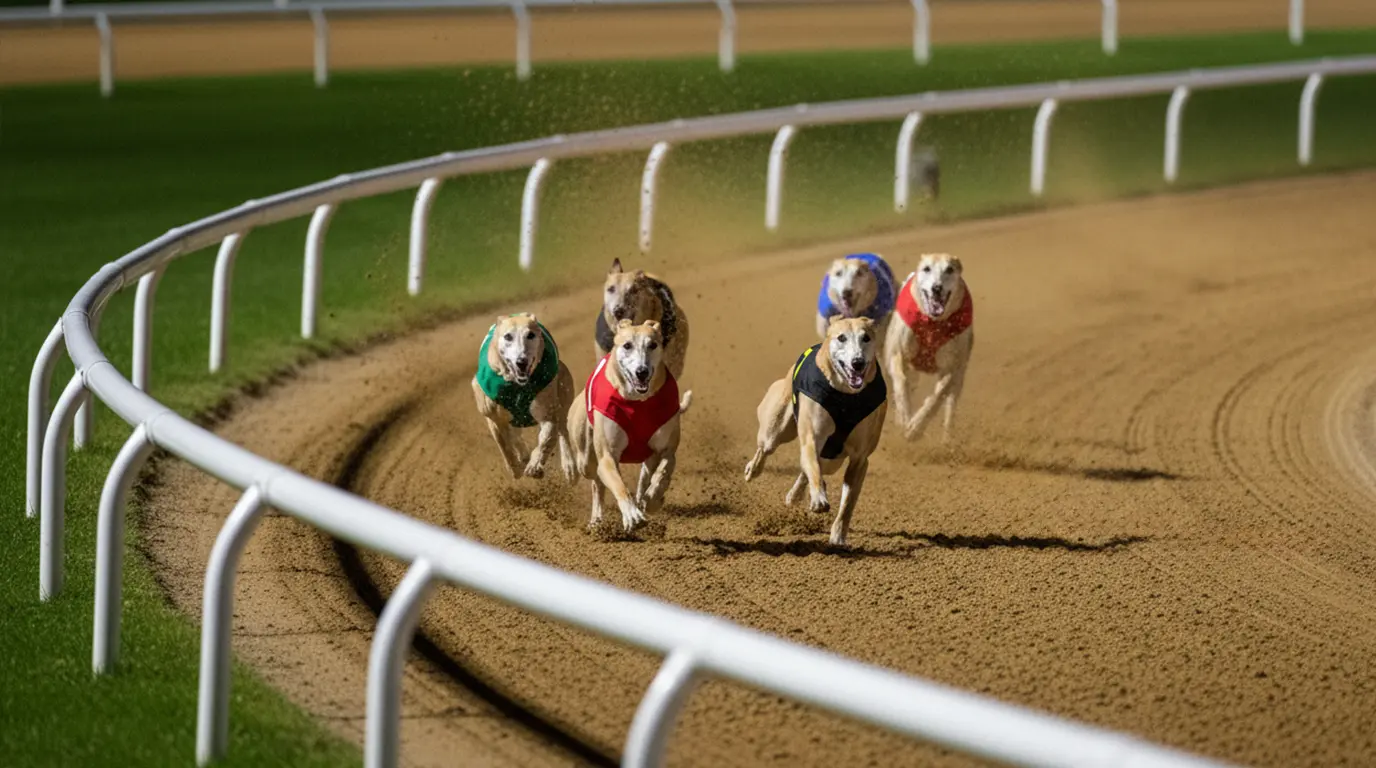
Understanding the Greyhound Grading System
A1 to A10 is not just a ranking — it is the engine that drives every graded card in the country. The grading system determines which dogs race against each other, and understanding it is essential because grade changes create some of the most exploitable betting opportunities in the sport.
At its simplest, A1 is the highest standard of graded racing at a track, descending from there. A dog that wins in A5 may be upgraded to A4, facing stiffer competition. Sustained poor performance leads to a downgrade. The criteria vary by track, but winning gets you promoted and consistent failure gets you dropped.
Beyond the standard A-grade ladder, there are Open Races — the highest level of competition, featuring the best dogs regardless of grade. Category One and Category Two opens form the backbone of the major race calendar, with prize money ranging from a few thousand pounds for midweek events to six figures for classics like the English Greyhound Derby. There are also sprint grades (D1, D2, and so on), middle-distance grades, stayers' grades, and hurdle grades, each operating on the same promotion-relegation logic.
Watch for grade changes. A dog stepping up from A5 to A4 after a comfortable win may suddenly face rivals two or three lengths faster at the new level. The market often overreacts to recent wins without factoring in the quality jump. Equally, a dog dropping from A3 to A4 after a troubled run — interference, bad draw, slow traps — may be underpriced because the form figures look poor even though the underlying ability has not changed. Grade shifts are where the racecard tells one story and the data tells another.
The practical impact on betting is direct. A dog at the top of its grade — winning comfortably and about to be upgraded — may look like a banker in its current race but is a risk in the next one. A dog that has just been downgraded into a weaker field, especially if the demotion was caused by circumstances rather than declining ability, often represents value. The punter who tracks grade movements across two or three meetings has an information advantage that the casual bettor, reacting only to the most recent form line, does not.
UK Greyhound Tracks: A Working Map
Eighteen licensed tracks, each with its own circuit, sand, and local quirks that reward the punter who pays attention. The GBGB currently oversees eighteen licensed stadiums across England and Wales, down from a peak of seventy-seven in the 1940s. Each venue has a distinct character: circuit size, bend radius, run-up distance, sand type, and prevailing conditions all shape race outcomes in ways that generic form figures do not capture.
The sport is celebrating its centenary in 2026, marking one hundred years since the first modern greyhound race under the mechanical hare took place at Belle Vue, Manchester, in 1926. The GBGB's centenary calendar features fifty Category One competitions and twenty-seven Category Two events spread across multiple venues, with the flagship English Greyhound Derby returning to Towcester from late April through to the final on 6 June. That schedule represents a concentrated burst of top-class racing, and for bettors, the open-race calendar is where the biggest markets and the deepest form data converge.
Track knowledge is the one edge bookmakers cannot price in. Learn two or three circuits well before spreading thin.
Specialising in a small number of tracks is the single most effective structural advantage a greyhound bettor can develop. Knowing that a specific circuit favours front-runners on wet sand, or that a particular bend configuration punishes middle runners, is the kind of granular intelligence that transforms generic selections into sharp ones. Below is a closer look at the key venues and the BAGS racing structure that keeps the afternoon cards running.
Interactive Tool
Track Decline Calculator, and Each-Way Break-Even Exact
Work out exactly how far the track network has shrunk since the 1940s peak, and the precise break-even price behind any each-way place fraction.
Decline From Peak
-
-
Peak (1940s)
-
Current
-
Remaining Share
-
What this guide leaves as two raw numbers: "eighteen licensed stadiums... down from a peak of seventy-seven in the 1940s." The percentage decline is never stated — the network has shrunk by 76.6%, meaning today's 18 tracks represent just 23.4% of the historical peak.
Exact Break-Even Odds
-
-
Place Fraction
-
Each-Way Outlay
-
Net at Break-Even
-
What this guide states without showing its working: "The break-even price for an each-way bet in a six-runner field with 1/4 odds on two places sits around 4/1." The word "around" undersells it — at exactly 1/4 place odds, the break-even is precisely 4/1, not an approximation.
Towcester, Romford, Nottingham: The Headline Venues
Towcester is the closest thing greyhound racing has to a flagship venue. The Northamptonshire track hosts the English Greyhound Derby — the sport's richest and most prestigious event, with a winner's prize of £125,000 in 2026, sponsored by Star Sports and Orchestrate. Towcester's circuit is one of the largest in Britain, with a long run-up to the first bend and a generous run-in that rewards closers and stamina runners. The track's reopening in 2020 after a period of closure restored it as the sport's centrepiece, and the six-week Derby festival each spring draws the highest-quality fields from British and Irish kennels alike.
Romford, in east London, runs a tight, fast circuit that heavily favours early-pace dogs drawn inside. It is one of the busiest tracks in the country, with evening and BAGS cards generating high-volume betting markets. The tight bends and short run-up punish wide runners and amplify the importance of the break from the traps. Romford is a specialist's track: dogs that win here regularly often struggle on larger circuits, and vice versa.
Nottingham operates a medium-sized oval that produces balanced racing — less extreme than Romford's trap-1 bias but not as expansive as Towcester. It hosts several Category One events and is a strong evening-meeting venue with reliable BAGS coverage. For punters, Nottingham's form tends to translate well to other mid-sized circuits, making it a useful reference point for cross-track comparison.
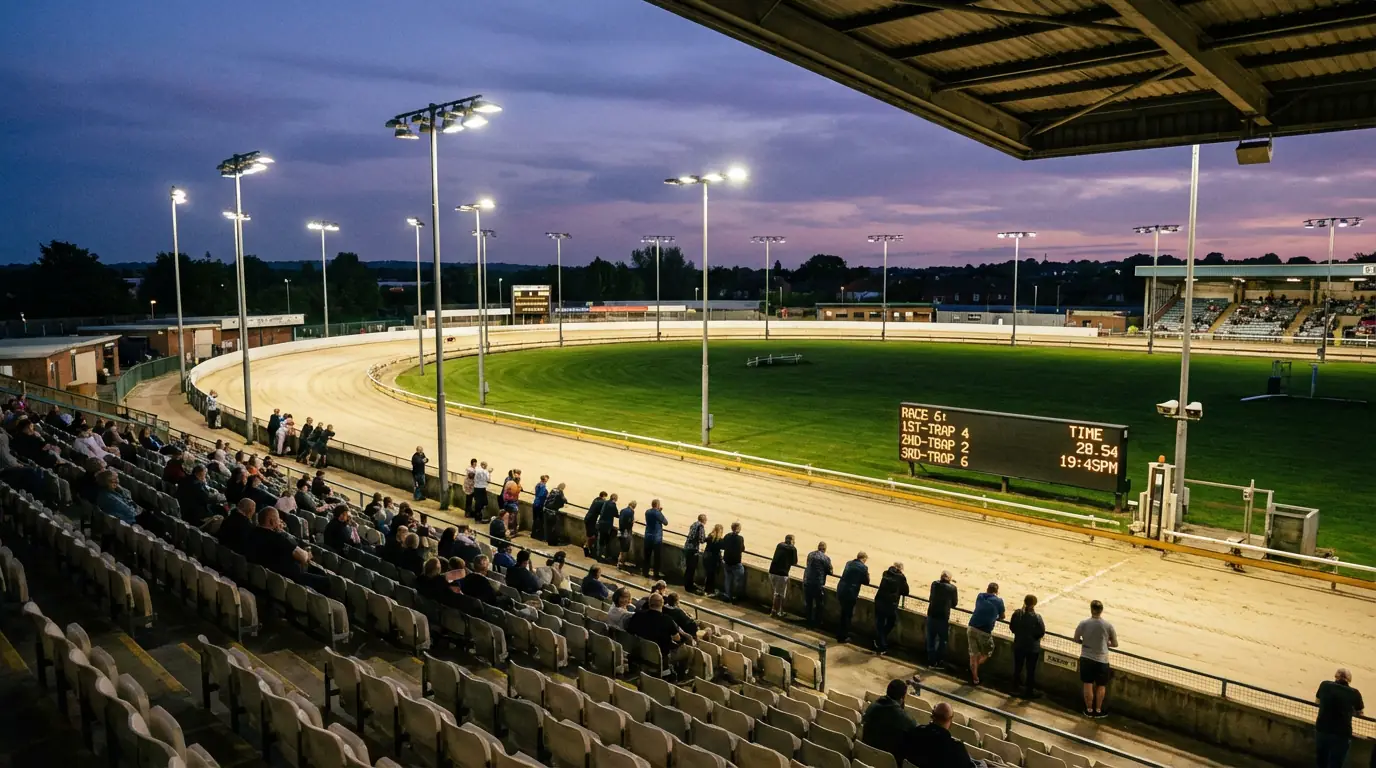
BAGS Tracks and Afternoon Racing
BAGS — the Bookmakers Afternoon Greyhound Service — is the system that keeps greyhound racing available in betting shops seven days a week. BAGS cards run in the morning and afternoon, scheduled specifically to provide content for off-course betting when evening racing has not yet begun. The meetings are shown on screens in licensed betting offices nationwide and streamed through online bookmakers.
The key difference between BAGS and evening racing is profile. Evening cards tend to feature stronger fields, higher-grade races, and more open competitions. BAGS meetings lean toward lower-grade action, graded cards where the form may be thinner and the quality of opposition less consistent. For the punter, this distinction matters: BAGS fields can be more predictable when a standout dog drops into a weak card, but they can also be volatile when the form is shallow and the dogs are tightly matched on ability.
Several tracks are BAGS-dominant, running more afternoon meetings than evening events. Sunderland, Central Park, and Doncaster are all regular BAGS venues. The punter who specialises in afternoon racing at one or two tracks — building up familiarity with local trainers, kennel form, and track tendencies — can develop an edge that the broader market, pricing based on headline form only, does not possess.
Core Greyhound Betting Strategy
Strategy in dog racing is not about systems — it is about consistently asking better questions than the market. No staking plan, no algorithm, no tip sheet replaces the discipline of working through a racecard methodically and identifying the spots where the odds do not reflect the actual probability. The market is efficient most of the time. The edge lies in the minority of races where it is not.
A structured approach to greyhound betting starts before you look at the odds. The sequence matters: analyse the form first, assess the draw, check the grade context, factor in conditions, and only then compare your assessment to the price. If the market agrees with you, there is no bet. If the market disagrees — if a dog you rate at 3/1 is available at 5/1 or bigger — you have a potential value selection. If you cannot find a discrepancy, you move to the next race.
Pre-Bet Checklist
- Check draw seeding — is each dog in the right trap for its running style?
- Review last three runs at this distance — ignore runs over different trips unless assessing stamina.
- Confirm grade level — has the dog been upgraded, downgraded, or stayed the same?
- Check weather and going — rain slows times and favours certain running styles.
- Look for kennel form — is the trainer's string in good shape or posting poor results across multiple dogs?
- Compare early price to your estimated probability — is there a gap worth exploiting?
The checklist is not a guarantee. It is a filter. Most races, after working through these steps, will not produce a bet worth placing. That is the point. The disciplined punter bets selectively, on the races where the analysis has revealed a genuine discrepancy between price and probability. The undisciplined punter bets on every race because the next one starts in twelve minutes. In greyhound racing, with its relentless schedule, the ability to pass on a race is the most underrated skill in the sport.
Using the Draw and Weather Together
The draw and weather do not operate independently — they compound. A dog drawn on the inside rail on dry sand may dominate the first bend and control the race. The same dog, drawn in the same trap on heavy, rain-soaked sand, may lose its early speed advantage because front-runners tend to suffer disproportionately on slow going. Combining draw analysis with conditions assessment is where composite selections start to emerge.
Rain is the most significant weather variable. Wet sand slows overall times but does not slow all dogs equally. Heavier dogs often handle wet conditions better, their weight helping them grip the surface. Lighter, pacier dogs can lose traction through the bends. Wind matters less than in horse racing — greyhound tracks are generally enclosed — but extreme cold can affect performance, particularly in older dogs or those returning from a break.
The practical step is simple: check the weather forecast for the track's location on race day, then cross-reference each dog's form on similar going. Race comments from previous wet-track runs will tell you whether a dog handled the conditions or struggled. A dog showing strong form on dry sand but with no wet-track experience is an unknown quantity when the rain arrives — and the market does not always discount that uncertainty enough.
Spotting Value in Greyhound Markets
Value in greyhound betting is not about backing winners. It is about backing dogs at odds that exceed their true probability of winning. A dog with a genuine 25% chance of winning — roughly 3/1 in probability terms — represents value at 5/1 and poor value at 2/1, regardless of whether it actually wins the race. Over time, consistently betting at prices above true probability produces profit. Consistently betting below it produces loss. The results of any single race are noise; the average return across hundreds of bets is signal.
Calculating implied probability from odds is straightforward: divide 1 by the decimal odds. A dog at 4/1 (decimal 5.0) has an implied probability of 20%. If your analysis suggests the dog's actual chance is closer to 30%, the overlay is significant — ten percentage points of edge on a single bet. That kind of gap does not appear in every race. When it does, the disciplined approach is to bet it, irrespective of whether the dog "looks" like a winner or whether the favourite appears strong.
The most common source of value in greyhound markets is the draw mismatch described earlier: well-drawn outsiders whose odds reflect their recent form but not their positional advantage. The second most common is the grade drop — a dog that has just been demoted after circumstances beyond its control and now faces weaker opposition at a price that still reflects its recent poor-looking form figures.
How Greyhound Odds Work
Greyhound odds move faster than almost any other sport — and the final price rarely matches the one you saw ten minutes earlier. In horse racing, major markets form over hours, with substantial each-way liquidity. In greyhound racing, the market often does not settle until the final few minutes before the off, and late money from on-course tote pools and exchange bettors can shift prices dramatically in the closing seconds.
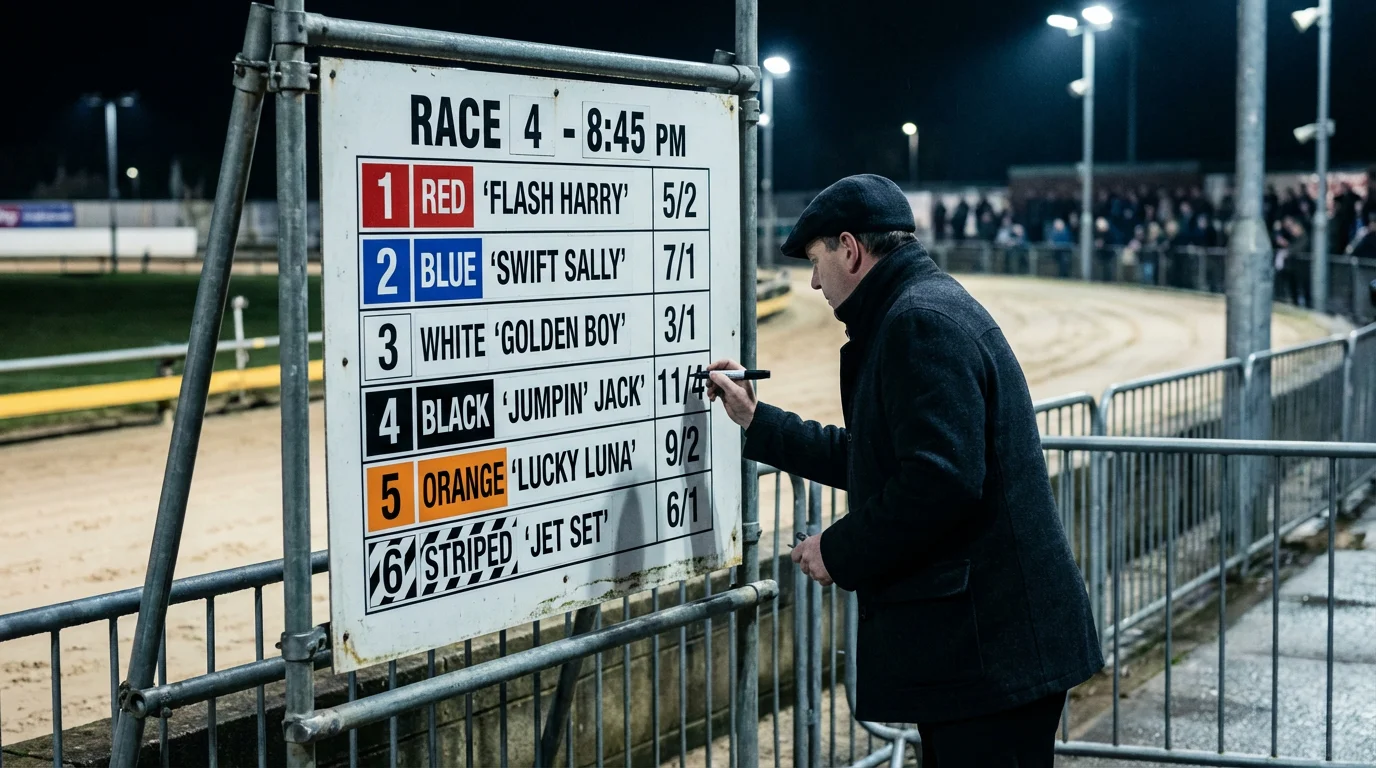
UK greyhound odds are traditionally displayed in fractional format: 5/2, 7/1, 11/4. Most online bookmakers now offer a decimal alternative, which is arithmetically simpler for calculating returns. In fractional odds, 5/2 means a winning £10 bet returns £25 plus the £10 stake. In decimal, the same price is displayed as 3.50 — multiply your stake by the decimal and you get the total return (£10 × 3.50 = £35). The formats represent the same thing; the choice is personal preference.
The starting price — SP — is the official price returned when the race begins, determined by on-course bookmakers at the track. If you take an early price with a bookmaker, your return is locked in at that number. If you take SP, you accept whatever the market settles at. The gap between early price and SP is the space where greyhound betting knowledge pays off. A dog you back at 6/1 in the morning that drifts to 8/1 by the off has given you worse value than the market eventually offered. A dog you back at 6/1 that tightens to 3/1 at SP has given you double the value. Best Odds Guaranteed, offered by most major bookmakers on greyhound racing, protects against this: if you take an early price and the SP is higher, you receive the bigger number.
Win Bet: £10 at 7/2
Fractional odds: 7/2 (for every £2 staked, profit is £7)
Decimal equivalent: 4.50
Potential profit: £10 × 3.5 = £35.00
Total return (stake + profit): £45.00
One characteristic of greyhound markets is their thinness. Horse racing prices are shaped by thousands of bets from early morning. Greyhound prices are set by fewer opinions and shift on modest volumes. This creates both risk and opportunity: the early price may not reflect true probabilities, but it can also be where the best value sits before the market self-corrects closer to the off.
Live Streaming and Virtual Greyhound Racing
Live streaming turned greyhound betting from a trip to the track into a sofa-based ritual — and virtual racing filled the gaps between cards. The two experiences are fundamentally different, and confusing them is a mistake that costs punters money.
Live greyhound streaming is widely available through major UK bookmakers' websites and apps. Services broadcast real races from GBGB-licensed tracks via SIS (Satellite Information Services) and, for major events, RPGTV. To access the stream, you typically need a funded account or to have placed a bet on the relevant meeting. The coverage is comprehensive: most BAGS cards and evening meetings are available, giving punters access to the full daily schedule from any device. The practical benefit is clear — you can watch the race your bet is riding on, assess how dogs are moving before the off, and build familiarity with tracks you cannot visit in person.
Virtual greyhound racing is an entirely separate product. Virtual races are generated by random number generators using computer-animated dogs on fictional circuits. There is no form to study, no draw to analyse, no grading system. The odds are set by software, and the outcome is random. Every analytical technique in this guide applies to live greyhound racing. None of it applies to virtual races — they are a lottery product with a visual wrapper.
In-play betting on live greyhound racing is limited — the races are too short for extensive in-running markets. The pre-race market, the five to ten minutes before the off, is where the real action happens and where final odds movements deliver the last pieces of information about market confidence.
Betting Smart: Bankroll Discipline and Responsible Gambling
Dog racing runs morning, afternoon and evening, seven days a week. That frequency is the risk, not the individual bet. A football punter might have twenty or thirty betting opportunities per weekend. A horse racing punter faces a few meetings a day. A greyhound punter can access dozens of races every single day of the year, from the first BAGS card in the morning to the last evening meeting after nine o'clock. The sheer volume of available action is what makes bankroll discipline non-negotiable.
The fundamentals are simple to state and difficult to maintain. Set a staking limit — a fixed percentage of your bankroll per bet, typically 1% to 3% — and do not deviate. Set a session limit: decide before you start how much you are prepared to lose, and stop when you reach it. Set deposit limits with your bookmaker; every licensed UK operator is required to offer them.
Self-exclusion tools are available through all UK-licensed operators and through the GAMSTOP national scheme, which allows you to exclude yourself from all UK-licensed online gambling sites simultaneously. If greyhound betting shifts from an enjoyable activity with structured decision-making into a compulsive pattern — if you are betting on races you have not analysed, if the volume is increasing, if losses are being chased — these tools exist for a reason, and using them is a rational decision, not a defeat. GambleAware provides free information and support at www.begambleaware.org.
Greyhound Betting: Key Questions Answered
How do greyhound racing odds work?
Greyhound racing odds represent the bookmaker's assessment of each dog's chance of winning. They are displayed in fractional format (e.g. 5/1 means you profit £5 for every £1 staked) or decimal format (e.g. 6.0 means a £1 stake returns £6 total). The shorter the odds, the more likely the market considers the dog to win. Odds are set by bookmakers in the morning and fluctuate through the day based on betting volume, finally settling at the Starting Price (SP) when the race begins. Most major bookmakers offer Best Odds Guaranteed on greyhounds, meaning if you take an early price and the SP is higher, you receive the bigger payout.
What is a forecast bet in greyhound racing?
A forecast bet requires you to predict the first two dogs to finish in a race. A straight forecast demands the exact finishing order — your selection for first must win and your selection for second must be the runner-up. A reverse forecast covers both permutations (either dog first or second) at double the stake. Combination forecasts allow you to select three or more dogs and cover every possible first-and-second pairing. Forecast dividends vary depending on the odds of the two placed dogs and are typically declared after the race by the tote or bookmaker. In a six-runner greyhound race, there are 30 possible straight forecast combinations, making them significantly easier to land than in a larger horse racing field.
What is the best trap position in greyhound racing?
Statistically, trap 1 (red jacket, inside rail) produces the highest win percentage at most UK tracks, because it has the shortest distance to the first bend and benefits from the rail. However, the "best" trap depends entirely on the dog drawn in it: a wide runner placed in trap 1 is disadvantaged despite the positional benefit, while a confirmed railer in trap 1 maximises its natural style. Trap bias also varies by track — some circuits favour outside traps over sprint distances, while others are heavily trap-1 dominated. The smartest approach is to check track-specific trap statistics and match them to each dog's running style rather than assuming one trap is universally superior.
From the Traps Forward: Where Your Edge Begins
The best greyhound punters do not predict winners — they identify races where the market has mispriced the draw. That distinction matters more than any tip, any system, and any staking plan. Dog racing rewards the punter who treats each racecard as a problem to solve rather than a lottery to enter.
Everything in this guide points toward the same conclusion: greyhound betting is a craft. The form card is your raw material. The draw, the grade, the conditions, the sectional times — these are your tools. The skill is in assembling them into a judgement that the market has not fully priced in, and then having the discipline to act on it only when the edge is real.
Start with one track. Learn its trap bias, its standard distances, the trainers who dominate its cards. Build familiarity with the dogs that race there regularly. Check the weather before every meeting. Read the race comments, not just the finishing positions. When you find a race where your analysis disagrees with the odds, back your judgement. When you cannot find that race, do nothing. The hardest lesson in greyhound betting is that the best bet is often no bet at all.
The sport is a hundred years old in 2026. The format has barely changed: six dogs, a mechanical hare, a sand track, and thirty seconds of pure speed. What has changed is the information available to punters. Race data, calculated times, track statistics, and form guides are all accessible to anyone with a screen and the patience to study them. The traps are open. The rest is up to you.
