UK Greyhound Racing Tracks: Circuit-by-Circuit Betting Guide
Best Greyhound Betting Sites – Bet on Greyhounds in 2026
Loading...
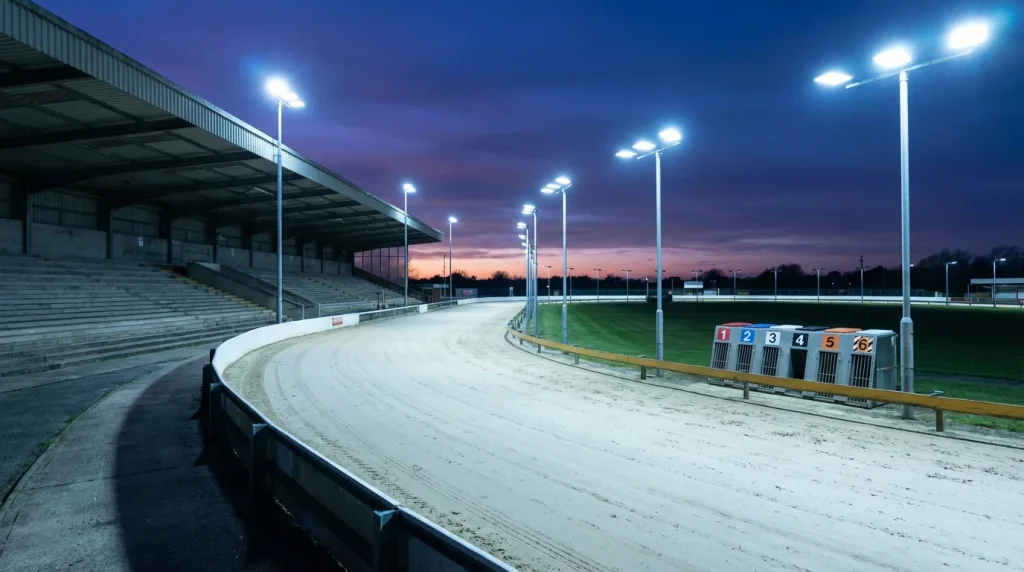
Not All Tracks Are Equal — And That’s Where the Edge Lives
Eighteen licensed tracks across England and Wales, each with its own sand, circuit size, and bend geometry. Generic betting won’t survive that variety. A punter who treats Romford and Towcester as interchangeable venues — same sport, same approach — is making a mistake that compounds with every bet. The two tracks share a name and a species but almost nothing else: different circumference, different bend radius, different run-up to the first turn, different sand composition, different drainage, different wind exposure. A dog that dominates at one may struggle at the other, and the reasons are physical, not psychological.
Track knowledge is the least glamorous edge in greyhound betting and arguably the most durable. Odds compilers and algorithms price greyhound races primarily on recent form, grading, and trap draw. They factor in track-specific data to varying degrees, but the granular detail — which circuit punishes wide runners on the third bend, which venue’s sand slows down after heavy rain, which track’s short run-up to the first turn gives Trap 1 an outsized advantage — is available to anyone willing to study it. The bookmaker’s model treats all tracks as inputs in the same formula. The specialist treats each track as a distinct betting environment with its own rules.
This guide covers every active GBGB-licensed greyhound track in the UK as of 2026, grouped by category and function. The aim is not a Wikipedia-style directory. It’s a working reference for punters who want to understand how track differences translate into betting opportunities — and why choosing two or three tracks to know deeply is more profitable than following all eighteen superficially.
Track Layouts and How They Shape Race Dynamics
Circuit size determines everything — which dogs lead, which dogs close, and where the trouble happens. UK greyhound tracks range from compact circuits of around 380 metres in circumference to larger ovals exceeding 450 metres. That variation sounds modest on paper, but its effect on race dynamics is dramatic. A larger circuit means wider bends, longer straights, and more room for dogs to find their running line without interference. A smaller circuit means tighter bends, shorter straights, and a premium on early pace because the first bend arrives faster and allows less time for the field to separate.
Bend geometry is the single most influential track variable for betting purposes. On tight bends, inside-drawn dogs hold a structural advantage: the rail is the shortest path, and a railer in Trap 1 can cut the corner while wider-drawn dogs are forced to cover extra ground. On wider, sweeping bends — the kind found at Towcester or Nottingham — the advantage shifts. Wide runners have more room to operate, the crowding on the inside rail is less severe, and the longer run from the last bend to the finish line gives closers a genuine chance to overhaul front-runners.
The run-up distance — the stretch from the traps to the first bend — varies significantly between tracks and directly affects trap bias. A short run-up compresses the field before the first bend, increasing the likelihood of crowding and giving inside traps a positional edge. A longer run-up allows the field to spread, which reduces interference and gives middle and wide-drawn dogs more time to establish their running line. When you study trap statistics at any given track, the run-up distance is the primary structural reason behind the numbers. Tracks with short run-ups consistently show a bias towards low-numbered traps. Tracks with longer run-ups produce more balanced results across the six boxes.
Surface is the final layer. All UK greyhound tracks use sand, but the composition, depth, and maintenance schedule vary. Some tracks run faster in dry conditions, producing quicker times and rewarding front-runners who can maintain speed on a firm surface. Others drain poorly, meaning that any rain slows the going and advantages dogs with stamina and a grinding running style. Knowing whether a track runs fast or slow, and how it responds to weather, is not arcane knowledge — it’s available through published going reports and track condition updates issued before each meeting.
The Major Circuits: Where the Big Races Run
Towcester, Nottingham, Hove — these tracks host the classics and set the standard. The UK’s top-tier greyhound venues regularly stage the major Category One open races (GBGB Category One and Two Racing Schedule), the championship events, and the competitions that attract the best dogs from kennels across the country. For a betting punter, the major circuits matter not because the racing is necessarily more profitable — the markets are sharper and the form is better known — but because they define the benchmarks against which all other tracks are measured. Understanding how these venues play is foundational knowledge, and detailed track profiles are available for every UK circuit.
Towcester: Home of the English Greyhound Derby
Towcester is the flagship venue of UK greyhound racing and the current home of the English Greyhound Derby (GBGB, English Greyhound Derby dates), the sport’s most prestigious event. The track is among the largest in the country, with a circumference that produces wide, sweeping bends and long straights. The standard distance is 480 metres over four bends, with sprint and stayers’ trips also on the card. Towcester’s size means that wide runners are less disadvantaged than at smaller circuits — there is room to run around the outside without losing prohibitive amounts of ground, and the long home straight gives closers a realistic chance of catching front-runners who have set a strong early pace.
For betting purposes, Towcester’s key characteristic is its relative fairness across the traps. The wider bends and longer run-up reduce the inside-rail bias that dominates smaller venues. Trap 1 still holds a slight advantage statistically, but Traps 4 and 6 perform better at Towcester than at most other tracks. Derby nights draw the deepest fields and the sharpest markets, meaning value is harder to find. The mid-week graded cards, where the market is thinner and the form less scrutinised, are where the opportunities tend to be.
Nottingham and Hove: Category One Venues
Nottingham operates one of the larger circuits outside Towcester and stages several major competitions throughout the year. The track favours dogs with a combination of early pace and stamina — the bends are wide enough to avoid severe inside-rail congestion, but the straights are long enough that dogs without finishing speed get found out. Nottingham’s graded racing is competitive, and the evening cards attract consistent betting volume, making the markets reasonably efficient. The value angles at Nottingham tend to revolve around grade changes and dogs transferring from smaller tracks where their form was achieved in a different physical context.
Hove, on the south coast near Brighton, is another Category One track with a distinctive circuit. It runs slightly tighter than Nottingham, which creates more of an inside-draw advantage and more first-bend congestion in lower-grade races where the seeding is less precise. Hove hosts the Sussex Cup and several prestigious invitation events. The coastal location means the track is more exposed to wind than inland venues, and weather conditions can shift quickly — a factor that disproportionately affects wide runners who are already covering extra ground. Punters who follow Hove regularly learn to check the weather forecast as routinely as the racecard.
Romford and Monmore: High-Volume Betting Tracks
Romford, in east London, is one of the busiest greyhound tracks in the country by betting turnover. It runs a compact circuit with relatively tight bends and a short run-up to the first turn — characteristics that create a pronounced bias towards inside-drawn dogs with early pace. Over large sample sizes, Traps 1 and 2 at Romford outperform the wider traps by a statistically significant margin. This doesn’t mean the inside always wins, but it means that ignoring the draw at Romford is ignoring the single biggest predictive factor at the track. The venue hosts both evening cards and BAGS afternoon meetings, giving punters frequent opportunities to apply track-specific knowledge.
Monmore Green in Wolverhampton occupies a similar niche — high-volume betting turnover, frequent cards, and a circuit that rewards specific types of dog. Monmore’s track is slightly larger than Romford’s, with bends that are marginally less tight, which softens the inside-draw bias without eliminating it. The track runs regular BAGS cards that attract consistent bookmaker attention, and the lower-grade BAGS races at Monmore are among the most bet-on greyhound events in the UK. For punters looking to specialise, Monmore offers the combination of high race frequency and a track character that rewards systematic analysis of draw and running style.
BAGS Tracks and Afternoon Racing Cards
Afternoon greyhound racing exists primarily to feed betting shops — and the form dynamics are noticeably different from evening cards. BAGS, the Bookmakers Afternoon Greyhound Service, is the system through which licensed tracks provide daytime racing specifically for the off-course betting market. BAGS cards run from late morning through the afternoon, typically at multiple tracks simultaneously, ensuring that betting shops and online bookmakers have a continuous supply of greyhound races to offer their customers throughout the day.
The practical difference between BAGS racing and evening racing matters for punters. BAGS cards tend to feature lower-grade races with smaller fields of less distinguished dogs. The grading at BAGS meetings can be looser, and the competition level is generally below what you’d find on a Saturday evening card at a major venue. This isn’t a criticism — it’s a structural reality that creates specific betting opportunities. Lower-grade BAGS races attract less public money, which means the markets are softer, the odds are less efficiently priced, and a punter with form knowledge can find overlays that wouldn’t exist in a well-scrutinised evening race.
The tracks that run regular BAGS fixtures include Crayford, Swindon, Kinsley, Central Park, and several others that rotate through the weekly schedule. Each BAGS track has its own circuit characteristics, and the same principles apply: learn the track geometry, understand the draw bias, and factor in the going. The one additional wrinkle with BAGS racing is that going conditions can change between the morning and the afternoon card if rain arrives, and the going report issued before the first race may not accurately reflect conditions by race six or seven. Checking updated going information during a BAGS card is a habit that separates attentive punters from autopilot bettors.
Race Distances Across UK Tracks
Sprint, standard, middle, marathon — every track has its own distance menu, and a dog’s distance preference is non-negotiable. UK greyhound racing cards four broad distance categories, and while the terminology is universal, the actual distances vary by track because each circuit has a different circumference and a different starting trap position for each trip.
Sprint races cover two bends, typically between 260 and 290 metres depending on the track. These are pure speed tests — the race is decided by trap speed, early pace, and the first bend. There is almost no time for a slow starter to recover, and wide runners are at a severe disadvantage because the race ends before they can make up the extra ground they cover on the bends. Sprint betting is draw-dominated, and inside traps with proven early pace win a disproportionate share of sprint races at virtually every UK venue.
Standard four-bend races are the backbone of UK greyhound racing, with distances ranging from approximately 450 to 500 metres depending on the circuit. This is the distance at which most graded racing takes place and where the form book is deepest. Four-bend races test a broader range of abilities — early pace still matters, but stamina, bend-running efficiency, and tactical positioning become significant factors. Dogs that specialise in sprints may tire over four bends, while stayers may not possess the early pace to be competitive in the opening stages. The standard trip is where form analysis is most reliable and where the interplay between draw, running style, and grade produces the most nuanced betting opportunities.
Middle-distance and marathon trips cover six bends or more, typically ranging from 640 to 900 metres. These races are less common on the average card but feature prominently in stayers’ competitions and some BAGS programmes. Stayers’ races reward dogs with genuine stamina and a sustainable cruising speed rather than explosive pace. The draw is less influential over longer distances because the field has more time to sort itself out, and the multiple additional bends give closers repeated opportunities to gain ground. Marathon betting is a niche within a niche, but punters who follow stayers’ form at tracks that regularly card long-distance races — Towcester, Nottingham, Monmore — can develop specialist knowledge that the general market doesn’t price in.
Regional Circuits Worth Knowing
Sheffield, Doncaster, Sunderland, Peterborough — the regional tracks rarely make headlines, but they produce the majority of bettable races. While the Category One venues attract the best dogs and the biggest crowds, the regional circuits carry the bulk of the UK’s weekly greyhound programme. These tracks run evening cards, BAGS meetings, and trial sessions, and they collectively account for more races per week than the major venues combined.
Sheffield is one of the better-known regional tracks, running a medium-sized circuit that produces competitive racing across the grading spectrum. The track has a loyal local following and a kennel base that provides consistent runners, which means the form book is relatively deep for a regional venue. Sheffield’s bends are neither especially tight nor especially wide, making it a track where the draw matters but doesn’t dominate in the way it does at smaller circuits. For punters looking to add a third track to their specialisation, Sheffield offers the advantage of frequent cards and form that can be studied systematically.
Doncaster and Sunderland occupy a similar tier — regular racing, moderate betting turnover, and form patterns that reward the attentive punter more than the casual one. These tracks tend to attract less public betting money than Romford or Nottingham, which means the markets are less efficient and the odds are more likely to contain pricing errors. A dog that drifts to 8/1 at Romford because the market is sharp and the money speaks might sit at 10/1 at Sunderland because fewer people are paying attention. That differential is the regional track advantage in a single number.
Peterborough, Crayford, Swindon, Kinsley, and Central Park round out the circuit map. Each has its own character: Crayford’s tight bends heavily favour inside runners, Swindon runs a larger circuit that produces more balanced results, and Kinsley operates primarily as a BAGS venue with frequent afternoon cards. The punter who picks one or two of these regional tracks and learns them thoroughly — studying trap bias data, tracking kennel form, noting going changes — will find more consistent betting edges than the generalist who dips into whichever track happens to be racing at the moment.
Choosing Tracks to Specialise In
Specialisation beats spread in greyhound betting. Pick two tracks. Learn them cold. This advice runs counter to the natural instinct of most punters, who prefer to bet across the full evening programme — a race at Romford, then Hove, then Nottingham, then whatever comes up next on the screen. The logic seems sound: more races mean more opportunities. In practice, more races without deep track knowledge mean more uninformed bets and a faster route to a depleted bankroll.
The selection criteria for your specialist tracks should be practical rather than romantic. Choose tracks that run frequently — at least three cards per week — so that you have enough races to study and enough betting opportunities to make the specialisation worthwhile. Choose tracks where form data is accessible, either through free racecard services or through dedicated greyhound data providers. And choose tracks whose schedules fit your availability. There’s no point specialising in a venue that runs BAGS cards at midday if you’re at work until six.
Once you’ve chosen your tracks, the work begins. Build a mental map of the circuit: the run-up distance, the bend tightness, the trap bias over the last three months, the going patterns in different weather, and the trainers whose dogs consistently run well at the venue. Track the form of every dog that races regularly at your circuits. After a few weeks, you’ll start recognising names, spotting returning dogs, and noticing when a dog has been redrawn from a bad trap to a good one without a corresponding shift in the odds. That recognition is the edge, and it’s only available to the punter who watches the same venue repeatedly rather than skimming across the entire programme.
The Home Straight: Track Knowledge as Long-Term Capital
A punter who knows Romford inside out will outperform a generalist with twice the bankroll. That is not motivational rhetoric — it’s a statement about how greyhound betting markets work. The market prices races based on publicly available form, and the market does a reasonable job of it most of the time. But the market’s model is national, not local. It weights trap draw and recent form, but it cannot fully capture the micro-level detail that a track specialist carries: the knowledge that Trap 3 at a specific venue has a drain cover that occasionally affects the running line, the awareness that a particular trainer always trials at Monmore before sending a dog to Romford, the instinct — built from hundreds of observed races — that a 7/1 shot drawn in Trap 1 on a wet Wednesday evening is actually a 3/1 chance in disguise.
Track knowledge compounds. Every card you study at your chosen venue adds to the database in your head, and that database becomes more accurate and more predictive over time. A punter six months into a Romford specialisation sees things that a first-time visitor cannot, and those observations translate directly into better bet selection and better value identification. The investment is time, not money. The return is an edge that no algorithm can replicate because it’s built from sustained, focused attention to a single environment. In a sport where the margins are thin and the markets are volatile, that focus is the closest thing to a genuine structural advantage available to any punter.