Weather and Track Conditions in Greyhound Racing
Best Greyhound Betting Sites – Bet on Greyhounds in 2026
Loading...
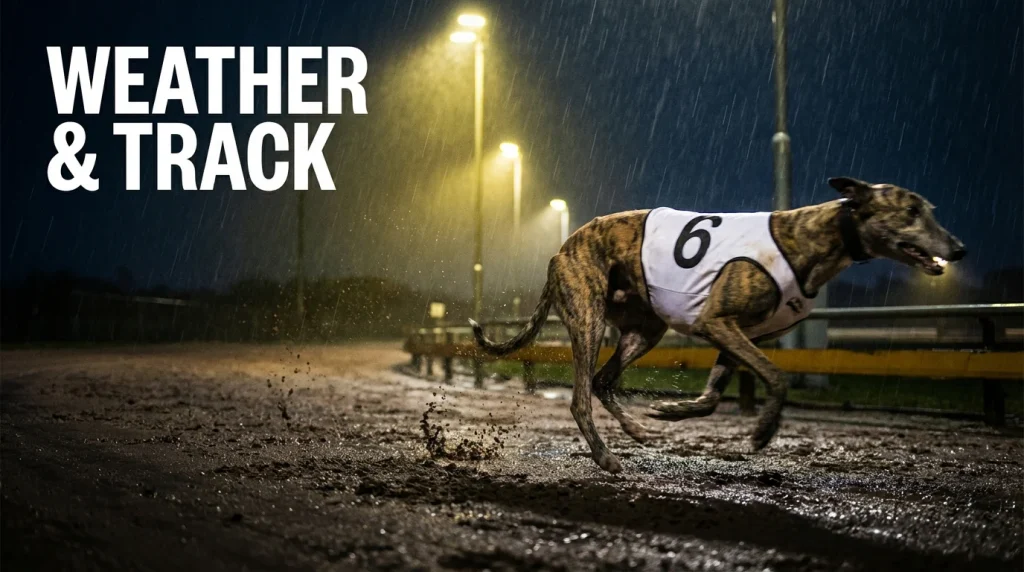
Rain Changes Everything — Especially the Form Book
A greyhound that ran 29.10 over 480 metres last Tuesday might run 29.60 over the same distance on the same track a week later. The dog hasn’t slowed down. The track has. Rain, temperature shifts, humidity and surface management all alter the racing surface, and when the surface changes, times change, running styles behave differently, and the form book — that careful record of past performances — becomes less reliable as a guide to what happens next.
Weather is the variable most casual greyhound punters ignore entirely. They check the form figures, note the times, compare the grades, and back the dog with the fastest recent run. What they don’t check is whether that fast run came on a dry, quick surface and whether today’s conditions are the opposite. That oversight is a gift to the punter who does check — because weather-driven changes in track conditions create systematic mispricings that the market corrects only slowly, if at all.
How Sand Track Surfaces Respond to Weather
Every UK greyhound track uses a sand-based surface. The composition varies — some tracks use finer sand, others a coarser grade, and most incorporate additives to manage drainage and consistency — but the fundamental material is the same. Sand is porous and responsive to moisture. When it’s dry, the surface is firm and fast. Times are quicker, grip is higher, and front-running dogs can maintain their speed through the bends. When it’s wet, the surface softens, the sand becomes heavier, and the energy required to drive through each stride increases. Times slow, and dogs with certain physical characteristics — typically bigger, more powerful animals — handle the change better than lighter, faster types.
Heavy rain transforms the track most dramatically. A downpour before or during a meeting can add anywhere from 0.20 to 0.50 seconds to standard times at a given distance, depending on intensity and duration. That margin sounds small, but in a sport where finishing margins are measured in heads and necks, half a second is an enormous difference. It can swing the result of a race entirely, turning a marginal form pick into a struggling also-ran while a dog with a less impressive time record on dry ground finds the softer surface to its liking.
Track management partially mitigates weather effects. Groundstaff at UK tracks harrow the surface between races, add sand or remove standing water, and aim to maintain a consistent going. Some tracks manage wet conditions better than others — larger circuits with better drainage systems return to a rideable surface more quickly than older, tighter tracks where water pools in the bends. This track-specific response means that the same rainfall affects Romford differently from Nottingham, and knowing how your target track handles weather is part of the preparation.
Which Dogs Handle Wet Conditions
Not every greyhound runs equally well on a wet track, and identifying the ones that do — or, more precisely, the ones that don’t suffer — is one of the more underused edges in greyhound betting.
The general profile of a wet-track performer is a dog with power rather than pure speed. Greyhounds built for explosive early pace rely on a firm surface to generate their acceleration. When the surface is heavy, that acceleration is blunted, and the early-speed advantage diminishes. Conversely, dogs that run more evenly — those with strong finishes rather than blistering first-bend speed — are less affected by the surface change because their running pattern doesn’t depend on the same explosive grip.
Running style interacts with conditions too. Railers on a wet track may find the inside line — where water tends to collect more heavily because it drains towards the rail — particularly slow. The inside strip can become the heaviest part of the surface, which means a dog hugging the rail is running through the worst ground. Wide runners, covering more distance but on a slightly better surface further from the drainage low point, can benefit. This isn’t a universal rule — it depends on the track’s drainage design — but it’s a factor worth noting at tracks you bet regularly.
The practical way to identify wet-track form is to look at the racecard comments from previous runs. If a dog’s comment includes phrases like “ran on well” or “stayed on” in races where the going was slow, that’s an indicator of aptitude. If the comments show “led early, faded” or “weakened” on slow-going nights, the dog is telling you it doesn’t handle the surface. This information is hidden in plain sight on every racecard — it just requires the punter to cross-reference run comments with the conditions on that particular race night.
Heat, Cold and Seasonal Performance Patterns
Rain gets the attention, but temperature has a subtler and more persistent effect on greyhound performance. Dogs are athletes, and like all athletes, their bodies respond to ambient temperature in ways that affect output.
In summer heat, particularly during heatwaves that push daytime temperatures above 30°C, greyhounds are more susceptible to fatigue and overheating. BAGS meetings running in early afternoon during July and August can be affected: dogs that raced twice in the previous week may show signs of tiredness, and race times across the card may be marginally slower as the heat takes a toll. Some trainers withdraw dogs from afternoon meetings during extreme heat, which can weaken fields and alter the competitive dynamics of individual races.
Cold conditions present different challenges. Winter meetings — particularly evening sessions under floodlights in December and January — are run on surfaces that can be hard and fast when dry, or heavy and clinging when wet. Dogs’ muscles take longer to warm up in cold conditions, and early-pace types may be marginally slower out of the traps. Hard frost can occasionally lead to meeting cancellations if the track surface becomes unsafe, which disrupts form continuity for dogs that miss scheduled races.
Seasonal patterns also affect the dog population. Many trainers give their better dogs a summer break, particularly if those dogs are targeted at major autumn and winter competitions. This means that summer BAGS cards may feature fewer top-grade animals, while autumn evening meetings see a resurgence of quality as rested dogs return to competition. For the bettor tracking kennel patterns, recognising when a good dog is being brought back from a break — and whether its initial return races are prep runs or genuine efforts — can flag opportunities that the wider market, reacting to bare form figures, will miss.
How to Check Track Conditions Before Betting
Checking conditions before betting is simple in principle and underused in practice. The most direct source is the track itself: many UK greyhound tracks post going reports on their social media accounts or websites before meetings, noting whether the surface is standard, slow, or heavy. SIS race data, distributed through bookmakers’ greyhound pages, sometimes includes a going description alongside the racecard.
Weather forecasts are the other essential tool. A basic check of rainfall data for the track’s postcode, using the Met Office or any standard weather service, tells you whether it rained in the hours before the meeting. If the forecast shows persistent rain during the meeting, you can expect times to slow progressively through the card — and the later races may run on a heavier surface than the early ones.
For regular punters, building a personal log of track conditions against race times over several months creates a dataset that no public service provides. If you know that a particular track’s times slow by 0.30 seconds in moderate rain and 0.50 in heavy rain, you can adjust your form comparisons accordingly. You can also identify which dogs in a given race have previously performed well on slow going at that specific venue. This kind of accumulated knowledge is the compound interest of serious greyhound betting: it takes time to build but pays dividends indefinitely.
Weather as Profit: When Conditions Create Mispricing
The market prices greyhound races primarily on form — times, finishing positions, grades, and recent results. What it doesn’t do efficiently is adjust for the effect of conditions on those historical performances. When the weather changes, the form book becomes a less accurate predictor, but the odds still reflect the form book’s assumptions.
This is where the weather-aware punter profits. If you know that today’s track is heavy and the market favourite posted its fast recent times on a dry surface, the favourite’s actual chance of winning has decreased — but its odds may not reflect that decrease. Meanwhile, a mid-priced dog with a history of strong performances on wet ground is underpriced relative to today’s conditions. The market has priced the race on static form. You’re pricing it on adjusted form. The gap between those two assessments is the edge, and it’s available every time the weather diverges significantly from the conditions under which the recent form was recorded.