Greyhound Tricast Betting Guide
Best Greyhound Betting Sites – Bet on Greyhounds in 2026
Loading...
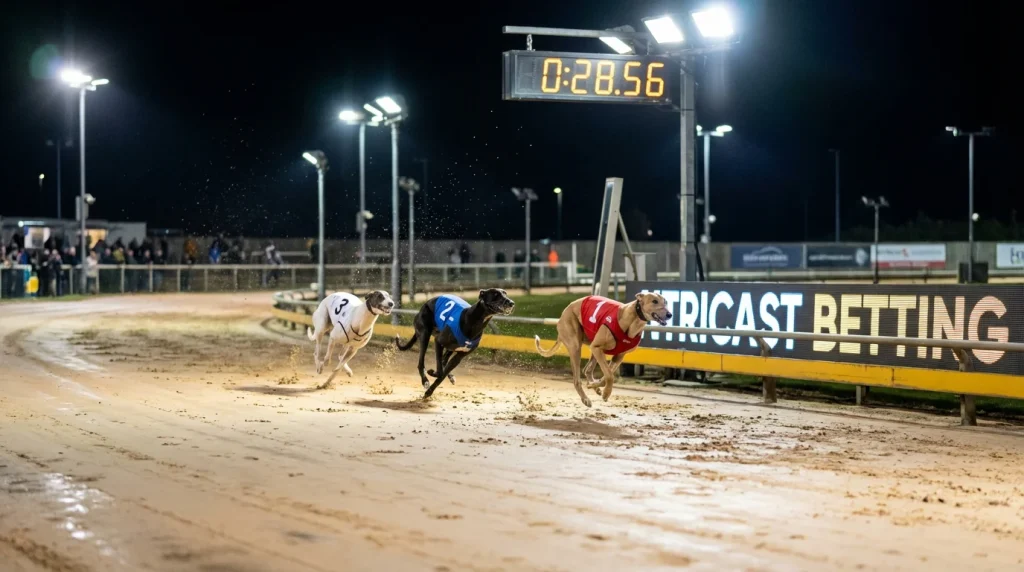
The Tricast: Big Dividends, Bigger Demands
Naming the first three home in order is the hardest standard bet in greyhound racing — and the payouts reflect it. Where a forecast asks you to predict two finishing positions, the tricast demands three. In a six-runner field, that means identifying one correct combination out of 120 possible permutations. The numbers explain both the appeal and the difficulty: tricast dividends routinely reach three figures, and four-figure returns happen with a frequency that no other single-race bet type matches.
The tricast sits at the top of the complexity scale for standard greyhound betting markets. It is not a bet for every race. It is a bet for races where the form, draw and grading combine to produce a situation you can genuinely read — and where the dividend will compensate for the many times you’ll get it wrong. Understanding how tricasts work, what they cost, and when they make analytical sense is the difference between chasing headlines and deploying them profitably.
Straight Tricast Mechanics
A straight tricast requires you to name the first, second and third finishers in the exact order. No flexibility on sequence, no forgiveness for a reversal in the minor places. If your three dogs fill the frame but the second and third swap positions, you lose. One bet, one outcome, one unit stake.
The dividend is calculated using the Computer Tricast formula, which takes the starting prices of all three placed dogs and derives a fair return. The calculation compounds improbability across three positions rather than two, which is why tricast dividends are typically three to five times higher than the forecast dividend for the same race. A race where the forecast pays £35 might produce a tricast of £150 or more, depending on the SP of the third dog.
The straight tricast’s virtue is its low cost relative to its potential return. A £1 straight tricast costs £1. For that single unit, you’re accessing a dividend structure that can pay back hundreds of times your stake. The catch is that you’re attempting to predict something that is objectively very difficult: the exact order of three animals in a short, chaotic race. Even experienced form students will miss more straight tricasts than they land. The bet works as a long-term play only if your winners pay enough to cover the losing streaks — and that depends on picking the right races, not on backing tricasts across every card.
Practically, the straight tricast rewards the same analytical approach as the straight forecast, with an added challenge: you need a view not just on who finishes first and second, but on which of the remaining dogs is most likely to hold third. That third position is the hardest to predict because it’s the most affected by race interference, bend scrimmaging and late-closing runs. Dogs who finish third are often there by circumstance rather than design, which is why the third-place component adds so much variance to the bet.
Combination Tricast: Costs and Coverage
If the straight tricast is a rifle shot, the combination tricast is a shotgun. You select three or more dogs to fill the first three places in any order, and the bet covers every possible permutation of those selections.
With three selections, the number of permutations is six (3 × 2 × 1). With four dogs, it rises to twenty-four. Five dogs: sixty. Six dogs in a six-runner race: all 120 possible finishing combinations — a guaranteed hit that guarantees a net loss. The cost escalation is steep.
| Selections | Permutations | Cost at £1 unit |
|---|---|---|
| 3 | 6 | £6 |
| 4 | 24 | £24 |
| 5 | 60 | £60 |
A three-dog combination tricast at £1 is manageable at £6, and it works when you’re confident in the three dogs but can’t determine their finishing order. This is its natural use case: races where the first three home seem identifiable but the sequence does not. The dividend you receive is the Computer Straight Tricast figure for the actual finishing order — the same as if you’d placed that specific straight tricast. So if the exact sequence pays £200, your £6 combination tricast returns £200 minus the £6 stake.
Four-dog combinations at £24 per unit become expensive, and the dividend needs to exceed that threshold to generate profit. Many punters reach for four-dog combinations because they can’t narrow the field to three, but that inability is itself information: if you can’t eliminate three dogs from a six-runner race, you probably don’t have enough of an edge to justify a tricast bet at all. The combination tricast should simplify a strong position, not disguise a weak one.
When Tricast Bets Make Sense
Not every race deserves a tricast. The bet type suits specific conditions, and deploying it indiscriminately is a reliable way to drain a betting bank.
The first condition is form clarity. Tricast races work best when you can identify three dogs with significantly better recent form than the rest of the field. If a six-runner race has three dogs graded A4 or above and three others at A7 or below, the form gap creates a natural frame for a tricast. The three stronger dogs should, in theory, dominate the places — the question is in what order.
The second condition is draw compatibility. If your three fancied runners are drawn with complementary running styles — say, a railer in trap 1, a middle runner in trap 3, and a wide runner in trap 6 — the risk of early-bend interference between them is lower. Three railers all drawn inside is a different proposition: they’ll scrimmage at the first bend, and the finishing order becomes a function of luck rather than ability.
The third condition is dividend expectation. Before placing a tricast, estimate whether the likely payout justifies the stake. If your three selections are the three shortest-priced dogs in the race, the declared dividend may be modest — perhaps £20 to £40. A £6 combination tricast on three favourites returns a small margin at best and a loss at worst. Tricasts pay when at least one of your selections is a mid-price or longer-priced runner, because that inflates the dividend without requiring a genuine outsider to perform.
The ideal tricast race is one where you have a strong idea of who fills the frame but the market hasn’t priced your combination as the most likely outcome. That disconnect between your read and the market’s read is where the value lives.
The Tricast Trap: Expectations vs Outcomes
Tricast betting has a psychology problem. The dividends are so large when they land that they create an illusion of consistent profitability. A £300 tricast return sticks in the memory far more vividly than the fifteen £6 combination bets that preceded it. Over those sixteen races, the punter spent £96 and won £300 — a genuine profit. But the next month, the same approach might produce zero winning tricasts across twenty attempts, costing £120 with nothing to show for it. The variance is extreme.
Honest self-assessment matters here more than with any other bet type. Track your tricast bets separately from your singles and forecasts. Calculate your actual return on investment over a meaningful sample — at least fifty attempts. If the numbers aren’t positive after fifty bets, the approach needs refining or the bet type doesn’t suit your strengths. Tricast betting punishes over-confidence and rewards patience, selectivity, and a genuine ability to read six-dog races at a level most casual punters never reach.
Precision Pays: The Tricast Mindset
The punter who profits from tricasts treats them as a specialist tool, not a default setting. One or two tricast bets per evening card — in races where the conditions genuinely align — is a sustainable rhythm. Five or six tricasts per card is entertainment spending disguised as strategy.
The tricast mindset is about restraint as much as analysis. You study the full card, identify the one or two races with a readable three-dog frame, and place your bet. The rest of the card gets assessed for forecasts, singles, or no bet at all. That selectivity is what turns a volatile bet type into a profitable one over time. The dividend does the heavy lifting — but only if you give it enough attempts with the right ammunition.