Greyhound Running Styles Explained
Best Greyhound Betting Sites – Bet on Greyhounds in 2026
Loading...
Railer, Middle, Wide: The Three Languages of Greyhound Movement
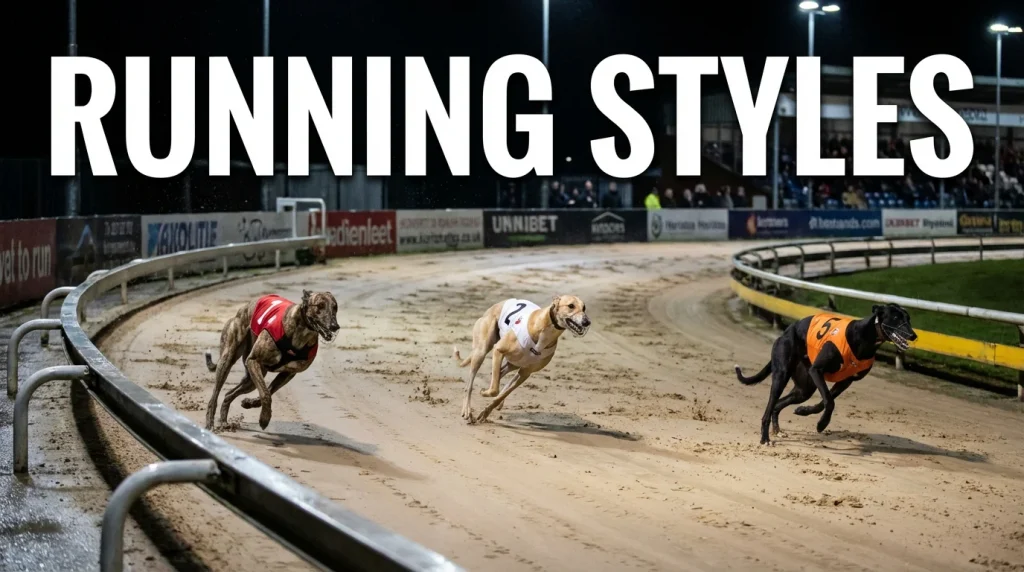
Watch any greyhound race from behind the traps and you’ll see it immediately: six dogs pulling in three different directions. Some cut sharply towards the inside rail. Others hold a central path through the middle of the track. A few swing out wide, seeking open space on the outside. These natural tendencies aren’t random. They’re ingrained behaviours — running styles that define how each greyhound races, how it interacts with the field, and how its starting position determines its chance of winning.
In UK greyhound racing, every registered dog is categorised by its running style: railer (R), middle (M), or wide (W). The classification appears on the racecard, informs the seeding process that assigns trap positions, and should be the first piece of information you check before forming any opinion about a race. A dog’s running style is as fixed as its preferred distance. It doesn’t change from race to race, and it dictates how the first bend — the most decisive point in any greyhound race — will play out for that runner.
For the bettor, understanding running styles is not academic. It’s the mechanism through which the trap draw creates or destroys value. A railer in trap 1 is a dog set up to succeed. A railer in trap 5 is a dog fighting against its own instincts. The running style, matched against the starting position, tells you more about a dog’s race-day prospect than its last three finishing positions ever could.
Railers: Inside Track Specialists
Railers want the rail. From the moment the traps open, they drive towards the inside running line and attempt to hug it around every bend. In a perfectly seeded race, railers start from traps 1 and 2 — the positions closest to the inside rail — and their path to the first bend is the shortest and most direct.
The railer’s advantage is positional efficiency. By running on the inside, it covers less ground than any dog taking a wider path. On a standard four-bend circuit, the distance advantage of the inside line can amount to several lengths over the full trip. A railer that leads into the first bend and maintains rail position through the race is extremely difficult to pass, because overtaking on the inside is blocked by the rail and overtaking on the outside means covering extra ground.
The railer’s vulnerability is crowding. When multiple railers are in the same race — especially if drawn next to each other — they compete for the same strip of track at the first bend. Two railers in traps 1 and 2 will both cut inward, and if the dog in trap 2 is faster to the bend, the trap 1 runner can be squeezed, bumped, or forced to check its stride. The result is interference that costs both dogs ground and can hand the race to a runner that avoided the trouble entirely.
Railers represent the largest proportion of running styles in UK greyhound racing. This numerical dominance means that many races have three or even four railers, creating a structural congestion problem on the inside. For the punter, a railer in trap 1 with no other railer directly to its outside is a strong positional play. A railer drawn in trap 3 or higher, with other railers between it and the rail, faces a problem the market doesn’t always price correctly.
Middle Runners: Flexible but Exposed
Middle runners take a line through the centre of the track — neither hugging the rail nor swinging wide. They’re typically seeded into traps 3 and 4, and their natural path offers a balance between the positional economy of the inside and the clear air of the outside.
The middle runner’s strength is flexibility. It can adjust its line in response to what happens around it. If the railers scrimmage at the first bend, a middle runner can pick its way through the inside gap or drift slightly wide to avoid the trouble. If the wide runners have vacated the middle of the track, it can hold its natural line without interference. This adaptability makes middle runners effective in races with unbalanced seedings, where the inside or outside is congested and the centre is open.
The weakness is exposure to traffic from both sides. A middle runner has dogs inside and outside of it, and at the first bend — where six dogs compress into a tighter formation — the middle position is the most likely to experience checking. A dog running through the middle has less predictability about its path than a railer or wide runner, because its options depend entirely on what the dogs on either side do. When two railers cut inside and two wide runners drift out, the middle runner has space. When the pack stays tight and nobody separates cleanly, the middle runner absorbs the most interference.
In betting terms, middle runners are the hardest style to assess positionally. Their success depends more on pace dynamics and the behaviour of adjacent dogs than on any structural advantage from the trap. Back them when the draw isolates them — when the dogs in traps 2 and 4 are likely to move away from the middle path, leaving clean running room. Be cautious when the draw clusters similar styles around them.
Wide Runners: Room to Manoeuvre
Wide runners take an outside path, sweeping around the bends with space between them and the pack. Seeded into traps 5 and 6, they sacrifice the shortest route for the clearest air, and their entire racing strategy depends on avoiding the congestion that affects the inside and middle of the track.
The wide runner’s advantage is clean running. While railers and middle runners jostle for position at the first bend, the wide runner swings around the outside with no interference. In races with heavy inside congestion — four or five railers fighting for rail position — the wide runner can inherit a lead simply by staying out of trouble. It doesn’t need to be the fastest dog in the race to benefit. It just needs the inside pack to slow each other down.
The disadvantage is ground coverage. A wide line adds genuine distance to the trip, and over four bends, the extra ground can be significant. A wide runner must be fast enough to compensate for the longer path, or it needs the inside dogs to lose enough time through interference to negate the distance penalty. This trade-off means that wide runners win fewer races overall than railers in UK racing — but when they win, they often do so at longer odds, because the market underestimates the positional advantage of clean air in chaotic races.
The single seeded wide runner — one wide runner in a race full of railers and middles — is one of the most reliable draw-based angles in greyhound betting. With no other dog competing for outside space, the sole wide runner gets an uncontested path while the pack fights over the inside. Track records consistently show that sole wide runners in traps 5 or 6 outperform their market odds at a statistically meaningful rate.
When Running Style Meets the Wrong Trap
The most dangerous scenario for any greyhound is a mismatch between running style and starting position. A railer drawn in trap 5 has to cross the paths of three or four other dogs to reach the inside rail. It will break from the trap, cut inward, and either find a gap — unlikely when several dogs are already running that line — or cause a collision at the first bend. Either way, its chance of running its natural race is compromised.
Similarly, a wide runner drawn in trap 1 has the opposite problem. It wants to drift outward, but it starts on the inside with five dogs between it and the open space it needs. The result is typically a slow start, as the dog hesitates or gets bumped while trying to move laterally rather than forward.
These mismatches are visible on the racecard before the race runs. The running style letter (R, M, W) next to the trap number tells the story. When you see a railer in trap 5 or a wide runner in trap 2, you’re looking at a dog that must overcome a structural disadvantage before its form, speed and stamina even come into play. The market may still price that dog on its recent results without fully discounting the positional problem, and that gap between expected ability and actual opportunity is where the shrewd punter finds an edge — either by opposing the mis-drawn dog or by backing a rival whose style matches its trap perfectly.
Reading the Run: Style as the First Bend’s Script
The first bend of a greyhound race is scripted by running styles, and you can read the script before the traps open. Look at the six dogs, note their styles, check their traps, and visualise the opening seconds. Which dogs will converge on the inside? Which will swing wide? Where will the crowding happen? Where will the space open up?
That thirty-second mental exercise is the most efficient form analysis you can do. It doesn’t require speed ratings, sectional times, or historical data. It requires only an understanding of how railers, middles, and wides behave — and the willingness to let that understanding guide your betting before you look at a single form figure. The dogs tell you how they’ll run. The trap draw tells you what happens when those preferences collide. Together, they write the script for the first bend — and the first bend, more often than not, writes the result.