Matched Betting with Greyhound Racing
 Available in US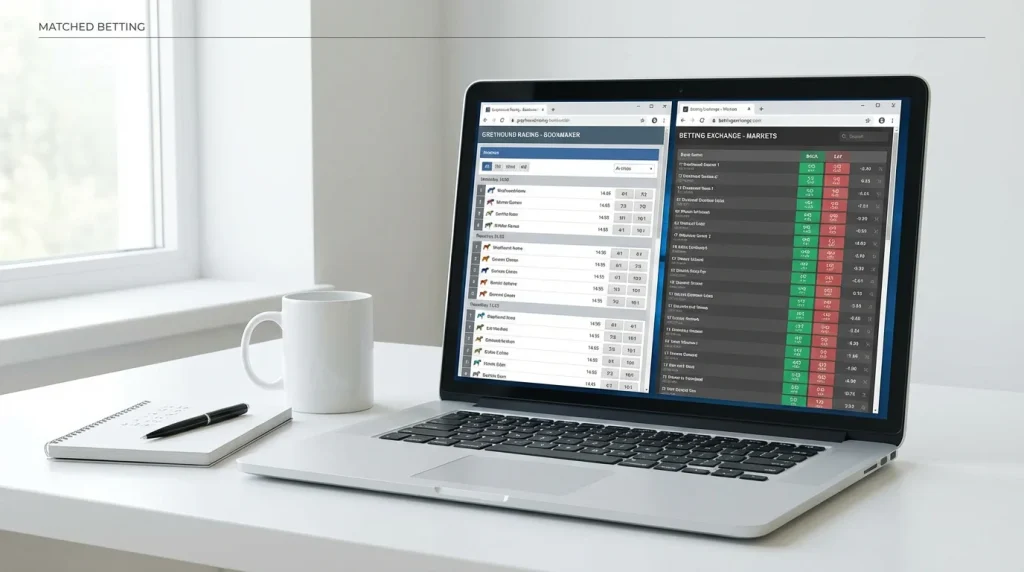
Greyhound Offers and Matched Betting: The Mechanics
Bookmakers pump out greyhound free bet offers every week — and matched betting is the technique for extracting guaranteed profit from them. Unlike standard betting, where the outcome determines whether you win or lose, matched betting uses opposing bets to lock in a return regardless of result. The profit comes from the free bet itself, not from predicting which dog crosses the line first. Find more strategy guides at dogracingbettinguk.
Greyhound racing is a productive arena for matched betting because bookmakers promote it heavily: free bet clubs, money-back specials, Best Odds Guaranteed promotions, and enhanced-odds offers appear on greyhound cards with regularity. Each of these offers can be converted into guaranteed profit through the matched betting process, provided you understand the mechanics, manage the maths precisely, and accept the operational constraints that come with using dog racing markets for this purpose.
What Is Matched Betting and How Does It Work?
Matched betting eliminates risk by placing two opposing bets on the same event: a back bet at a bookmaker (betting a dog will win) and a lay bet at a betting exchange (betting the same dog will not win). The two bets cancel each other out, meaning you neither win nor lose on the race itself. The profit comes from the free bet or promotional offer that one of those bets unlocks.
The process has two stages. First, the qualifying bet: you place a normal bet at the bookmaker to meet the conditions of the offer (for example, “bet £10 on any greyhound race to receive a £5 free bet”). You simultaneously lay the same selection on an exchange for a similar amount, so the qualifying bet produces a small loss or breaks even. Second, the free bet: once triggered, you place the free bet at the bookmaker on another selection and lay it again at the exchange. The free bet costs you nothing (it’s funded by the bookmaker), and by laying it, you lock in a profit equal to roughly 70–80% of the free bet’s face value, minus exchange commission.
This is not gambling. The outcome of the race is irrelevant to your profit. The maths works because the bookmaker is paying for the free bet as a customer acquisition or retention cost, and matched betting redirects that cost into the punter’s pocket. It’s a mathematical extraction technique, legal, and widely practised across UK betting markets.
Greyhound-Specific Offers Worth Using
Several types of greyhound promotions lend themselves to matched betting. The most common and valuable are free bet clubs, money-back offers, and Best Odds Guaranteed.
Free bet clubs are recurring promotions where the bookmaker awards a free bet (typically £5 or £10) each week in exchange for placing a qualifying bet on greyhound racing. Betfred, Coral, and other major firms have run versions of this offer. The free bet can be extracted through the standard back-and-lay process, generating £3–£8 of profit per week depending on the free bet value and the available odds. Over a year, a single free bet club running at £5 per week produces roughly £200 in low-effort profit.
Money-back specials — such as “money back as a free bet if your dog finishes second to the favourite” — are harder to extract cleanly because the refund is conditional on a specific outcome. However, they still carry positive expected value for the matched bettor, because the lay side covers the primary loss scenario and the occasional refund provides a bonus.
Best Odds Guaranteed is not a traditional matched betting offer, but it enhances the value of the qualifying process. When BOG is active, any SP drift on your qualifying bet works in your favour: you keep the better price without additional risk, which can improve the qualifying loss or even turn it into a small profit before the free bet is triggered.
Qualifying Bets and Extraction on Dog Races
Greyhound races have relatively thin exchange liquidity — which affects your lay price and your overall extraction rate. This is the primary operational challenge of matched betting on dogs compared to horse racing or football, where exchange markets are deeper and the back-lay spread is tighter.
When placing a qualifying bet, you want the back price at the bookmaker and the lay price at the exchange to be as close as possible. The smaller the gap, the smaller your qualifying loss. On popular evening greyhound meetings, the exchange liquidity is adequate — back-lay spreads of one or two ticks are achievable. On BAGS afternoon cards from smaller tracks, the exchange market may be thin or non-existent, and the spread can widen to several points, making the qualifying loss unacceptably large.
The practical approach is to qualify on evening meetings at well-traded tracks — Romford, Nottingham, Towcester, Monmore — where the exchange liquidity supports tight spreads. Avoid qualifying on obscure BAGS cards where the lay market is too thin to match efficiently. For the free bet itself, the same principle applies: place it on a selection where the exchange offers sufficient liquidity to lay at a reasonable price.
Timing matters too. Exchange liquidity on greyhound races increases in the final fifteen minutes before the off. Placing your back and lay bets close to race time maximises the chance of finding a tight spread and getting your lay matched promptly.
Limitations and Risk Management
Matched betting on greyhounds works, but it has boundaries. Account restrictions — commonly known as “gubbing” — are the most significant. Bookmakers monitor betting patterns and may limit or remove promotional access for customers they identify as matched bettors. Signs that trigger restrictions include consistently using free bets on high-odds selections, never betting outside promotional offers, and always backing one selection while laying it elsewhere.
Mitigating gubbing risk involves mixing matched bets with occasional non-promotional bets (known as “mush bets”), varying your staking patterns, and not always choosing the highest-odds selection for free bet placement. These measures don’t guarantee immunity, but they extend the lifespan of your accounts. Some matched bettors maintain accounts across a dozen or more bookmakers, rotating activity to avoid triggering any single firm’s detection algorithms.
Exchange liquidity risk is the other operational concern. If your lay bet isn’t matched before the race starts, you’re exposed to the race result as a standard bet rather than a hedged one. Always check that your lay has been fully matched before the off, and use the exchange’s “keep” or “in-play” settings with caution. On greyhound markets specifically, partially matched lays are more common than on horse racing due to the lower overall volume, so confirming full match status is a non-negotiable step in the process. Also explore our greyhound betting strategy.
Not Free Money — Free Bets: The Difference Matters
Matched betting on greyhounds works. It also requires precision, exchange access, and respect for the maths. The profit is real — but it’s earned, not given. The bookmaker doesn’t want you to extract value from their promotions, and the exchange takes its commission on every lay bet. Your profit is the margin between the two, and maintaining that margin requires discipline, accurate calculation, and an awareness of the operational risks that come with the process. Treat it as a skill, not a shortcut, and it will serve you well.
