Greyhound Forecast Betting Explained
Best Greyhound Betting Sites – Bet on Greyhounds in 2026
Loading...
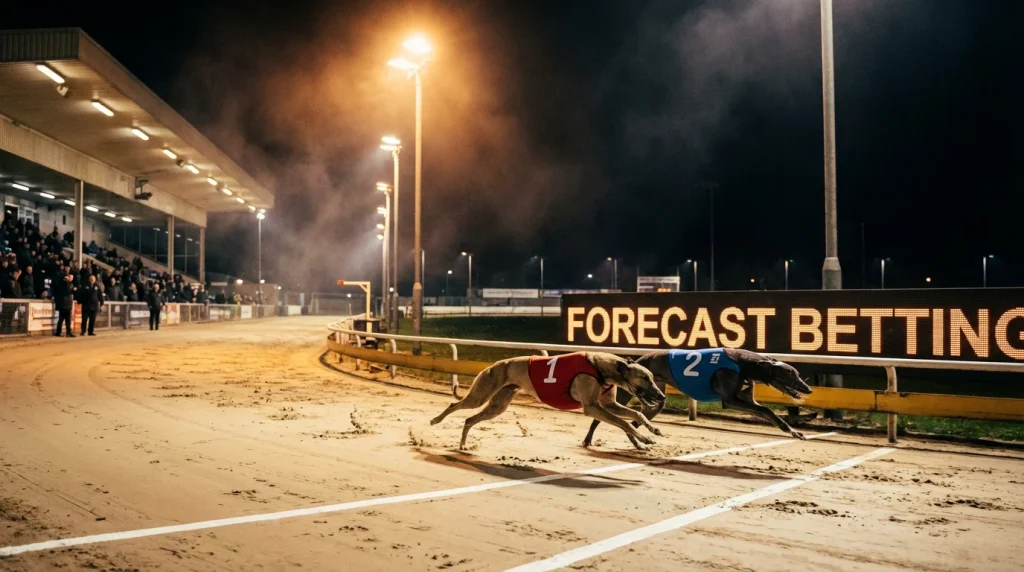
Why Forecasts Are the Punter’s Sweet Spot
The forecast bet is where greyhound racing rewards genuine form study — not guesswork. While a win single asks you to identify one dog from six, the forecast demands you name the first two home. That additional layer of precision is what makes the payout structure so attractive, and it is why forecast betting remains the preferred market for punters who take greyhound analysis seriously.
In a six-runner field, there are thirty possible first-and-second combinations. The returns reflect that difficulty. A winning forecast regularly pays ten, twenty, sometimes fifty times your stake on a standard graded race. When two outsiders fill the first two places, three-figure dividends are not unusual. Compare that to a win single at 3/1, where you collect four pounds for every one wagered, and the appeal becomes obvious.
What separates forecast betting from other exotic markets is accessibility. You don’t need to predict the entire finishing order. You don’t need specialist software. You need an informed opinion on two dogs, a basic understanding of how dividends work, and the discipline to leave races alone when the form doesn’t give you enough to go on. Every evening card at every UK track offers multiple races where forecast betting is both realistic and potentially profitable — provided you approach it with a method rather than a pin.
Straight Forecast: First and Second in Order
One bet, exact order, high dividend — the straight forecast is simple in concept and demanding in execution. You select two dogs: one to finish first, one to finish second, in precisely that sequence. If your two selections fill the first two places but in reverse order, you lose. There is no flexibility.
The appeal is cost efficiency. A straight forecast is a single unit stake. Place a £1 straight forecast, you risk £1. The dividend is declared after the race using the Computer Straight Forecast formula, which calculates the return based on the starting prices of the first two finishers. The higher the combined prices, the bigger the payout. Two short-priced dogs filling the frame might return £8. Two mid-range outsiders might return £80 or more.
The CSF formula is worth understanding at a conceptual level even if you never run the numbers yourself. It takes the SP of the winner, the SP of the second-place finisher, and adjusts for the number of runners. In a six-dog race, the returned dividend is typically close to what you would get by multiplying the winner’s SP by the second dog’s adjusted odds — though the precise maths involves a correction factor that accounts for the favourite’s position in the result. The practical takeaway: forecast dividends scale exponentially with price, not linearly. A 10/1 winner paired with an 8/1 second produces a dramatically bigger dividend than a 5/1 winner paired with a 4/1 second, despite the prices not looking wildly different on the racecard.
Straight forecasts work best when you have a strong view on the likely winner and a specific opinion about which dog will follow it home. This is not the same as picking two dogs you fancy. The second selection should be based on positional logic — draw, running style, likely pace scenario — not on general quality. A railer in trap 1 who leads the field into the first bend will often be followed home by whichever dog settles into second on the inside running line. That dynamic gives you a structural basis for forecasting rather than a speculative one.
Reverse Forecast: Two Dogs, Any Order
The reverse forecast doubles your cost but covers the margin of error. You still select two dogs to fill the first two places, but the order doesn’t matter. It is effectively two straight forecasts wrapped into a single bet: Dog A first and Dog B second, plus Dog B first and Dog A second. A £1 reverse forecast costs £2.
Only one of those two permutations can pay out, and the dividend is the same CSF figure you would have received from a straight forecast on that finishing order. The extra pound doesn’t reduce the payout — it buys you insurance against getting the sequence wrong.
This bet makes practical sense in a specific type of race: one where you are confident two dogs will dominate the frame but cannot separate them. Two well-drawn dogs of similar ability, perhaps one with slightly more early pace and the other with a stronger finish, present a genuine coin-toss on the exact order. Forcing yourself to pick a sequence in that situation is not analysis — it is guesswork with a 50% failure rate. The reverse forecast removes that coin-toss and lets your form opinion stand without being undermined by sequencing luck.
Where it becomes a problem is when punters default to reverse forecasts on every race because they cannot commit to a sequence. That habit doubles your total outlay across a card without improving your selection quality. If you have a genuine directional view — you believe Dog A is clearly faster than Dog B — the straight forecast is the correct bet. Reserve the reverse for the races where the order is authentically uncertain, not for every race where picking feels uncomfortable. The test is simple: if you would confidently back one of the two selections in a head-to-head, you don’t need the reverse.
Combination Forecasts: Multiple Selections
Combination forecasts scale up quickly — and most punters underestimate how many bets they’re actually placing. A combination forecast lets you select three or more dogs to fill the first two places in any order. The bet covers every possible first-and-second permutation among your selections.
The arithmetic is straightforward but catches people out. With three selections, the number of permutations is six (three dogs times two remaining for the second spot). With four, it rises to twelve. Five selections produce twenty permutations. Each permutation is a separate bet at your unit stake.
| Selections | Permutations | Cost at £1 unit stake |
|---|---|---|
| 2 | 2 | £2 |
| 3 | 6 | £6 |
| 4 | 12 | £12 |
| 5 | 20 | £20 |
A £1 combination forecast on four dogs costs £12, and only one of those twelve permutations can win. The dividend you receive is the CSF for whatever finishing order actually occurs — the same figure a straight forecast on that exact combination would have returned. So your profit margin depends entirely on whether that single paying permutation returns more than the total outlay.
This creates a clear constraint. The more dogs you include, the higher the breakeven dividend needs to be. A three-dog combination costing £6 is manageable: most CSF results in competitive races will exceed that. A four-dog combination at £12 requires a decent-sized dividend just to break even, and the dividend is only large if at least one of the first two finishers is a longer-priced runner. A five-dog combination at £20 is rarely justified unless you genuinely expect a two-outsider result.
The productive use of combination forecasts sits in open, competitive races where you can eliminate two or three dogs with confidence but cannot separate the remainder. If a six-runner race has two dogs you can cross out — one poorly drawn, one returning from a long layoff — you are left with four live contenders. A four-dog combination at £12 is a structured way to play that view. The discipline is in the elimination, not the inclusion. Every dog you add to the combination raises the cost and dilutes the return. The best combination forecast punters are the ones who are most willing to cross dogs out.
What Drives Forecast Dividends
The bigger the prices of the first two home, the bigger the forecast dividend — but correlation isn’t profit. Understanding what drives the CSF figure helps you estimate whether a forecast bet is worth the stake before you place it.
The Computer Straight Forecast takes the starting prices of the first and second finishers as its primary inputs. When two short-priced dogs fill the places, the dividend is low — sometimes barely worth the effort. When two longer-priced runners come home first and second, the CSF compounds the improbability and produces a correspondingly larger return. A 4/1 winner followed by a 3/1 second might generate a CSF of around £20. A 10/1 winner followed by a 7/1 second could produce £100 or more.
The relationship between the two prices is multiplicative, not additive. This is the key mechanical point. The CSF doesn’t simply add the two prices together — it compounds them, which means that two moderately priced dogs finishing first and second can produce a dividend far bigger than you might intuitively expect. It also means that one short-priced dog in the frame drastically reduces the payout, even if the other finisher is a long shot.
For the bettor, the implication is clear. Forecast value concentrates in races where you disagree with the market about two dogs, not just one. If you believe a 6/1 shot will win and a 5/1 shot will follow it home — and the market expects neither outcome — the resulting CSF, if you are right, will be substantial. The skill is not in backing outsiders randomly. It is in identifying specific two-dog combinations that the market has underpriced because it overrates a rival, misjudges the draw, or fails to account for a grade change.
Building Forecasts That Pay: A Sharper Approach
The best forecast punters don’t pick two dogs — they eliminate four. That inversion of the selection process is what separates profitable forecast betting from hopeful speculation.
Start with the racecard and work backwards. Which dogs can you confidently remove from contention? A wide runner drawn in trap 1 is a candidate. A dog stepping up two grades on its first race back from injury is another. A greyhound whose last three runs show checked form and slow sectional times is a third. Once you have narrowed the field to two or three genuine contenders, the forecast writes itself: either a straight if you can sequence them, or a reverse or small combination if you can’t.
Then layer in the draw and running styles. If your two remaining contenders are a railer drawn in trap 1 and a wide runner drawn in trap 6, the likelihood of them interfering with each other is minimal — which increases the probability of both finishing in the frame without trouble. If instead both are railers drawn in traps 1 and 2, the first-bend dynamic matters: who has the early pace to lead, and will the other one settle for second or get shuffled back? Those details point you toward the straight forecast and the correct sequence.
Forecast betting is not a novelty side market. For punters willing to do the work, it is the most rewarding standard bet in greyhound racing. The dividend structure pays for precision, the cost per bet is low, and the analytical process forces you to engage with the race properly. That combination — low entry cost, high return ceiling, analytical rigour required — is exactly what makes it the punter’s sweet spot.