Greyhound Bet Types: Every Market Explained With Worked Examples
Best Greyhound Betting Sites – Bet on Greyhounds in 2026
Loading...
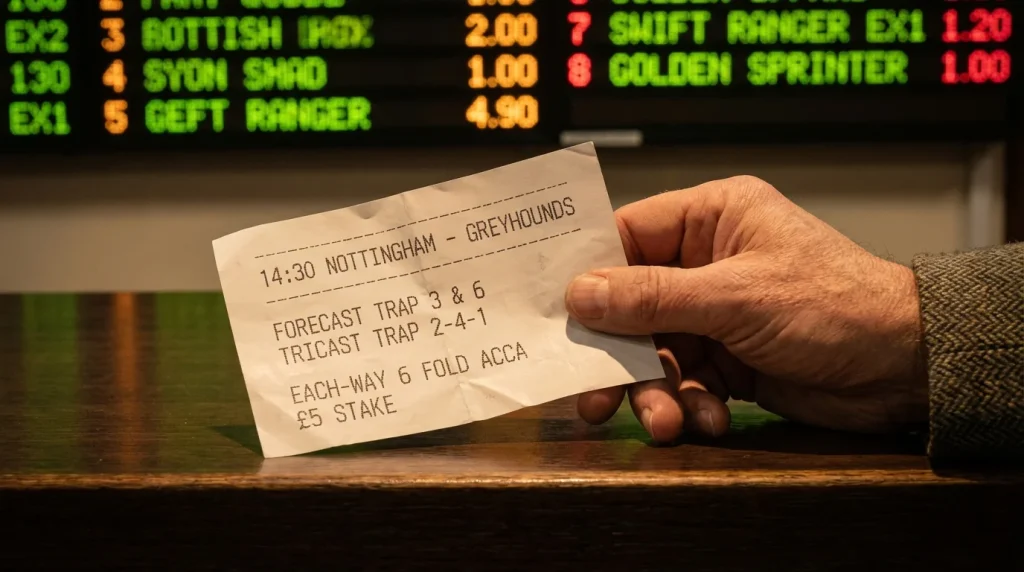
Beyond the Win Bet: Why Greyhound Markets Deserve Your Full Attention
Most punters bet win-only on dogs. They’re leaving money — and better odds — on the table. Walk into any betting shop during an afternoon BAGS card, and you’ll see the same pattern repeated at every screen: a quick scan of the racecard, a glance at the favourite’s price, and a win single slapped down before the traps open. It works often enough to feel like a strategy. It isn’t.
Greyhound racing offers a wider menu of bet types than most punters ever explore, and the reason matters more than curiosity. Each market — from the straightforward win bet to the more complex combination tricast — exists because it captures a different kind of edge. The win bet rewards conviction about one dog. The forecast rewards an understanding of how the race will unfold from first to second. The tricast pays out when you can read the draw, the pace, and the closing speed of half the field. These aren’t just variations on a theme. They’re fundamentally different betting propositions, each with its own risk profile, its own payout structure, and its own logic.
The gap between a punter who bets win-only and one who uses the full range of greyhound markets is not about sophistication for its own sake. It’s about precision. A race where you fancy one dog to lead but can’t separate the chasers is a terrible win bet and a natural forecast. A six-dog field where the favourite is cramped in the wrong trap but three outsiders have clear runs is screaming for a combination tricast, not a reluctant each-way. And once you see the full menu, going back to win-only feels like ordering the same dish at a restaurant you’ve never properly read the menu of.
This guide breaks down every greyhound bet type available through UK bookmakers in 2026, with worked examples and practical context for each. The goal is not to make you bet more. It’s to make you bet with the right instrument for each race.
Win and Place Bets
The win bet is where everyone starts, but the place bet is where discipline lives. Together, they form the foundation of greyhound wagering — two market types that seem simple until you start thinking about when each one is the correct choice rather than the comfortable one.
Win and place bets account for the overwhelming majority of greyhound turnover in UK betting shops and online. They’re the default not because they’re the best option but because they require the least thought. That’s fine for casual punting. If you’re trying to beat the market consistently, though, you need to understand the mechanics beneath the surface, including how place terms work in a six-runner field, what happens to your expected value when you shift from win to place, and why the starting price on a greyhound can drift or shorten dramatically in the final sixty seconds before the traps.
How Win Bets Work in Greyhound Racing
A win bet on a greyhound does exactly what it says: your dog must finish first. No complications, no partial payouts, no consolation prizes. You back Trap 3 at 7/2, and if it crosses the line ahead of the other five, you collect. If it finishes second by a short head, you lose your stake.
The simplicity is the appeal, but there are details worth knowing. In greyhound racing, the starting price is determined by on-course bookmakers at GBGB-licensed tracks and by the betting exchanges and bookmaker algorithms for BAGS meetings. Unlike horse racing, where the SP is formed across a ring of on-course layers, greyhound SPs can be volatile — especially in lower-grade races where the market is thin. If you take an early price online, you lock in your odds at the point of the bet. If you leave it to SP, you’re at the mercy of late market moves, which in greyhound racing can be significant. A dog that opens at 5/1 might go off at 3/1 if money arrives in the final two minutes, or drift to 8/1 if connections have cooled. Early price versus SP is a genuine tactical decision in dog racing, not a formality.
Win bets work best when you have strong conviction about a single dog — typically a well-drawn favourite or a fit outsider with a clear run to the first bend. In races where the draw is congested and multiple dogs have legitimate claims, the win single is a blunt instrument. That’s where the rest of this guide earns its keep.
Place Betting: Terms and Payout Structure
Place betting on greyhounds follows a different structure from horse racing, and the distinction matters for your bottom line. In a standard six-runner greyhound race, the place terms offered by most UK bookmakers are first or second at a fraction of the win odds — typically one quarter of the odds for two places. Some bookmakers extend to three places on selected races, but this is less common in greyhounds than in horse racing and usually comes with reduced fractional terms.
Here’s the practical calculation. If you back a dog at 6/1 for a place at quarter odds, your place portion pays 6/4 (or 3/2) if the dog finishes first or second. A £10 place bet at those terms returns £25 — your £10 stake plus £15 profit. That’s a meaningful return, but it’s a fraction of the £70 you’d collect from a winning £10 bet at 6/1. The trade-off is obvious: you halve your requirement (first or second instead of first) but you slash the payout.
Place-only bets make tactical sense in specific scenarios. When you’ve identified a dog that will be competitive but faces a stronger rival with a better draw, a place bet isolates your edge without requiring your selection to beat the one dog you think it probably can’t. Place betting also has a role in races with a short-priced favourite — if the jolly is 4/6 and your selection is 5/1, backing for a place at 5/4 can represent better value than trying to win a race dominated by a class act. The key is running the numbers before you commit, not after.
Each-Way Betting on Greyhounds
Each-way is the most misused bet in dog racing — and understanding when it fails is more important than knowing how it works. An each-way bet is two bets in one: a win stake and a place stake at the same amount. You’re effectively backing your dog to win and separately backing it to place, at the bookmaker’s place terms. If the dog wins, both parts pay out. If it places but doesn’t win, you lose the win stake and collect on the place portion. If it finishes outside the places, you lose both.
The mechanics are straightforward. The misapplication is everywhere. Punters reach for each-way as a safety net — a way of hedging a selection they’re not fully confident about. The logic feels sound: “I think this dog can win, but just in case, I’ll take each-way.” The problem is that this reasoning ignores the mathematics. An each-way bet at short odds is almost always a losing proposition because the place portion pays so little relative to the total outlay. Back a 2/1 shot each-way in a six-runner greyhound race, and your place part pays 2/4 (1/2) at quarter-odds terms. A £10 each-way bet costs £20 total. If the dog places but doesn’t win, you get back £15 on the place portion — a net loss of £5 on the overall stake. You need the dog to win to make the bet profitable, which means the each-way element has added cost without adding value.
The break-even point for each-way greyhound betting sits higher than most punters realise. With standard quarter-odds, two-place terms, each-way only begins to offer genuine protection at odds of roughly 4/1 and above — and genuine value at longer prices where the place portion alone can return a profit on the combined stake.
When Does Each-Way Offer Genuine Value?
Each-way betting earns its place in your armoury under specific conditions, and they’re narrower than the betting industry would have you believe. The ideal each-way greyhound bet has three characteristics: the selection is priced at 5/1 or longer, the race is competitive enough that the favourite can be beaten, and your dog has strong place claims even if it doesn’t win — typically because it has early pace or a favourable draw that guarantees a clean run to at least second.
Consider a practical example. You’ve identified a dog at 8/1 in a six-runner race at Romford. It’s a railer drawn in Trap 1 with a fast break, but it tends to find one too good in the closing stages. The favourite is drawn in Trap 6 — a wide runner who’ll need to make ground on the bends. Your dog has clear place credentials. At 8/1 each-way with quarter-odds for two places, your place part pays 2/1. A £10 each-way bet (£20 total) returns £30 on the place alone if the dog finishes second — a £10 profit even without winning. If it wins, you collect £90 on the win portion plus £30 on the place, totalling £120 from a £20 outlay. That’s the profile of a sensible each-way bet: the place portion is self-sustaining.
Where each-way fails is in short-priced selections, in races with a dominant favourite where your dog’s realistic ceiling is second, and in any situation where you’re using each-way as emotional insurance rather than a calculated position. If you wouldn’t back the dog for a place as a standalone bet, you shouldn’t be taking each-way.
Forecast Bets: Straight, Reverse and Combination
Forecasts are where greyhound betting gets interesting — and expensive, if you don’t count your bets. A forecast requires you to predict the first two finishers. In a straight forecast, you must name them in the correct order. Get the dogs right but the order wrong, and you lose. The dividend is calculated by the Tote or declared by the bookmaker based on a computer straight forecast, and the payouts can be substantial because the bet is harder to land than a simple win.
Greyhound racing is particularly well suited to forecast betting for reasons that don’t apply to most other sports. With only six runners, the number of possible first-and-second combinations is manageable — thirty permutations in a straight forecast. Compare that to a twelve-runner horse race with 132 permutations and the mathematics of the greyhound forecast start to look considerably friendlier. More importantly, the draw and running-style dynamics in greyhound racing mean that certain first-and-second combinations are structurally more likely than others. A railer in Trap 1 and a wide runner in Trap 6 often have clear, unimpeded runs, making them natural forecast partners when the middle dogs are fighting for the same ground.
Straight Forecast: Picking First and Second in Order
The straight forecast is the purest form of this bet. You nominate Dog A to finish first and Dog B to finish second, in that exact order. The appeal is the dividend — because the bet is harder to land, the returns are significantly higher than a win single on either dog individually. A typical straight forecast on a greyhound race might return anywhere from 5/1 to 80/1 or more, depending on the prices of the two dogs involved. When a well-fancied favourite wins and the second favourite fills second, the forecast dividend will be modest. When a 6/1 shot beats a 10/1 shot in the correct order, the payout escalates sharply.
The straight forecast demands genuine analytical conviction. You’re not just saying this dog will win — you’re saying it will win and that specific dog will be the one chasing it home. This level of precision requires you to think about the race in sequence: which dog leads out of the traps, which dog has the early pace to sit second through the bends, and which dogs are likely to fade or encounter trouble. Done well, forecast betting transforms a single race into a layered analytical exercise. Done badly — picking two dogs you vaguely fancy and hoping for the best — it’s an expensive habit.
Reverse and Combination Forecasts: Covering More Outcomes
The reverse forecast is the forecast with a safety catch. You still name two dogs, but you’re covering both possible finishing orders: A first and B second, or B first and A second. It costs twice the unit stake — two bets instead of one — but it removes the requirement to predict the exact order. If both dogs fill the first two positions in either arrangement, you collect the declared computer forecast dividend for the order they actually finished in.
Reverse forecasts are sensible when you’re confident about which two dogs will fill the frame but can’t separate them. Two well-drawn dogs with contrasting running styles — one a front-runner, the other a closer — are a classic reverse forecast scenario. The front-runner leads more often than not, but when the closer has a strong final bend, the positions can swap. A reverse forecast covers both scripts.
Combination forecasts extend the same principle to three or more selections. A combination forecast with three named dogs covers all six possible first-and-second permutations (three dogs, each potentially finishing first or second with either of the other two). The cost is six times the unit stake. With four dogs, you’re looking at twelve permutations and twelve times the stake. The arithmetic climbs quickly, and this is where discipline matters. A £2 combination forecast on four dogs costs £24 — and the declared dividend needs to exceed that for the bet to be profitable. In practice, combination forecasts work best when you’ve identified a competitive race with three genuine contenders and can’t confidently separate them. Beyond three dogs, the cost usually outweighs the expected return unless the dividend is exceptionally large.
Tricast Bets: Straight and Combination
The tricast is the greyhound equivalent of a lottery ticket — except the odds are readable if you study the form. A tricast requires you to predict the first three finishers. In a straight tricast, the order must be exact: first, second and third as you’ve named them. The dividends are the largest of any standard greyhound bet type, routinely running into three figures and occasionally hitting four.
Greyhound racing makes tricast betting more approachable than it might seem. In a six-runner field, a straight tricast has 120 possible permutations — significantly fewer than in horse racing where larger fields create thousands of combinations. The reduced field size means that careful form analysis can meaningfully narrow the viable permutations. If you can confidently eliminate two dogs from contention based on the draw, the grade, or recent form, you’re working with a pool of four realistic finishers, which reduces the straight tricast permutations to just 24.
The combination tricast follows the same logic as the combination forecast but applied to three positions. You name three or more dogs and cover every possible finishing order across the first three places. With three named dogs, that’s six permutations (six times the unit stake). With four dogs, it’s 24 permutations. With five, it’s 60. The cost escalates fast, and this is where tricast betting can drain a bankroll if you’re not careful. A £1 combination tricast on five dogs costs £60 — and you need a declared dividend that clears that hurdle for the bet to be worthwhile.
The sweet spot for tricast betting is a competitive race at a lower grade where the field is closely matched and the draw creates a credible narrative for three specific dogs. A1 and A2 races at well-known tracks like Romford or Nottingham tend to produce lower tricast dividends because the favourites are more predictable. Drop down to A5 or A6, where the form is more volatile and the market less efficient, and the tricast dividends grow — along with the analytical challenge. The punters who consistently find tricast value are the ones who know which dogs handle crowding, which ones fade over the final fifty metres, and which ones have the trap speed to grab an early position regardless of the draw.
Accumulators, Doubles and Trebles
Greyhound accumulators look seductive on paper. In practice, they are a bankroll’s worst enemy. An accumulator links two or more selections across different races, with the returns from each winning leg rolling onto the next. A £5 double on two 3/1 shots returns £80 if both win. A £5 treble on three 3/1 selections returns £320. A four-fold hits £1,280. The numbers on the betslip are intoxicating, and that’s precisely the problem.
The mathematics of accumulators work relentlessly against the punter. Each additional leg multiplies not just the potential return but also the probability of failure. If your single-bet strike rate is 25 per cent — respectable for greyhound win betting — then a double has a 6.25 per cent chance of landing, a treble 1.56 per cent, and a four-fold 0.39 per cent. You’d need to place 256 four-fold accumulators at those odds to expect one winner statistically. Meanwhile, the bookmaker’s margin compounds at every stage, because the overround in each race’s market is baked into every leg. A five per cent margin per race becomes a cumulative drag that makes long accumulators structurally unprofitable over time.
This doesn’t mean multiples are always wrong. Doubles and trebles — the shortest accumulators — can be legitimate betting tools when used selectively. A double linking two strong-conviction bets at value prices is a reasonable way to amplify returns without the catastrophic failure rates of longer accumulators. The discipline is in limiting the legs. Two selections where you have genuine analytical edge, combined into a double, is a calculated position. Six selections strung together because they all “look good” is a donation to the bookmaker.
If you do bet accumulators on greyhounds, apply the same rigour to each leg that you’d apply to a single bet. Every selection should stand on its own merits — form, draw, grade, track. If any leg is there because you needed to fill the coupon rather than because the analysis demanded it, the accumulator is already compromised. And keep the stakes modest. The whole point of a multiple is leverage: a small stake producing a large return. If you’re putting significant money on four-folds and above, you’re misunderstanding the instrument.
Speciality Markets: Trap Challenge, Inside vs Outside, Winning Distance
Beyond the core markets, bookmakers offer novelty bets that occasionally hide genuine edges. These speciality markets don’t feature on every race and they’re not available with every bookmaker, but when they do appear, they reward a particular kind of analysis that the standard win and forecast markets don’t capture.
The trap challenge is one of the more common speciality bets. It pits two named dogs against each other in a head-to-head — whichever of the two finishes ahead of the other wins the bet, regardless of where either finishes in the overall race. This is a useful market when you have a clear view on a matchup but no confidence in either dog winning outright. If Trap 2 and Trap 5 are closely matched on form but the draw heavily favours Trap 2, a trap challenge bet isolates that advantage without requiring Trap 2 to beat the entire field.
Inside versus outside bets divide the six traps into two groups — typically Traps 1, 2 and 3 against Traps 4, 5 and 6 — and you back which group will produce the winner. This is crude but not without logic. At tracks with tight bends that favour inside runners, such as Crayford or Romford, the inside traps win disproportionately over large sample sizes. If you know the track bias and the seeding hasn’t corrected for it, inside/outside can offer a low-effort edge.
Winning distance bets let you predict the margin of victory: will the winner win by more or fewer than a specified number of lengths? This market is most interesting in races with a clear front-runner drawn in a favourable trap. If the likely leader has early pace and the chasers are known to be slow starters, a bet on a wide winning margin becomes a form-based proposition rather than a guess. The bookmakers price these markets less efficiently than the core markets because they attract less volume, and lower volume means softer lines. Not every speciality bet is worth taking, but when the analysis aligns, they can provide returns that the headline markets don’t.
Matching the Bet Type to the Race
The bet type should follow from the race analysis, not the other way around. This sounds obvious, and yet the default behaviour of most greyhound punters is exactly the reverse — they decide they want to bet a win single or an each-way before they’ve properly assessed the race. The market you choose should be the last decision, not the first.
Start with the race itself. Study the racecard: draw, form, grade, distance, running styles. Then ask a sequence of questions. Can you identify a clear winner? If yes, and the price offers value, a win bet is the right instrument. If you can’t separate the top two but you’re confident they’ll fill the frame, a reverse forecast captures that view. If the race is wide open but you can eliminate the weaker dogs, a combination tricast might be the play. If you fancy one dog to be involved but the favourite looks unbeatable, a place bet or an each-way at the right price lets you profit without needing first.
The discipline is in matching the structure of your analysis to the structure of the bet. A forecast makes no sense if you can’t articulate why Dog A beats Dog B specifically rather than the rest of the field. A tricast is unjustifiable if you’re guessing at the third dog. An accumulator linking races at different tracks is only defensible if every single leg carries genuine conviction. The bet type is a tool, and tools are defined by the job at hand. A hammer is useless when the job calls for a screwdriver, no matter how much you like hammers.
One practical framework: after completing your race analysis, write down your view in one sentence before looking at the betting options. “Trap 1 wins if it gets a clear run” points to a win bet. “Traps 1 and 4 dominate but either could lead” points to a reverse forecast. “Open race, three live chances, the rest are weak” points to a combination tricast. Let the sentence choose the bet.
The Punter’s Last Turn: Timing and Bet Selection
The best greyhound bets are placed when you’ve answered every question — not when you’ve run out of time. Greyhound markets close fast. From the moment the runners are paraded to the traps opening, you might have three to five minutes to finalise your position. That’s not enough time to analyse a race from scratch, but it is enough time to make a critical timing decision: take the price now or wait for SP.
For win and place bets, the early price versus SP question is the last tactical call. If you’ve identified value at the current price and you believe the market will shorten, take the early price and lock it in. If you suspect money will come for other runners and your selection will drift, SP might serve you better. Best Odds Guaranteed, where the bookmaker pays whichever is higher, removes this dilemma — but not every bookmaker offers BOG on every greyhound meeting, and BAGS races are frequently excluded.
For forecasts and tricasts, timing is less relevant because these bets are settled at declared dividends rather than at the odds you take. Your job is simply to get the bet on before the off. The real timing discipline with forecasts and tricasts is earlier in the process — deciding whether the race merits that bet type before you’re swept up in the final-minute market moves.
Every bet type covered in this guide has a place in a serious greyhound punter’s toolkit, but none of them work without the groundwork: form reading, draw analysis, grade awareness and a clear view of the race before the price appears on screen. The market you choose is the last move in a longer process. Make the process count, and the bet selection takes care of itself.