Greyhound Ante-Post Betting
Best Greyhound Betting Sites – Bet on Greyhounds in 2026
Loading...
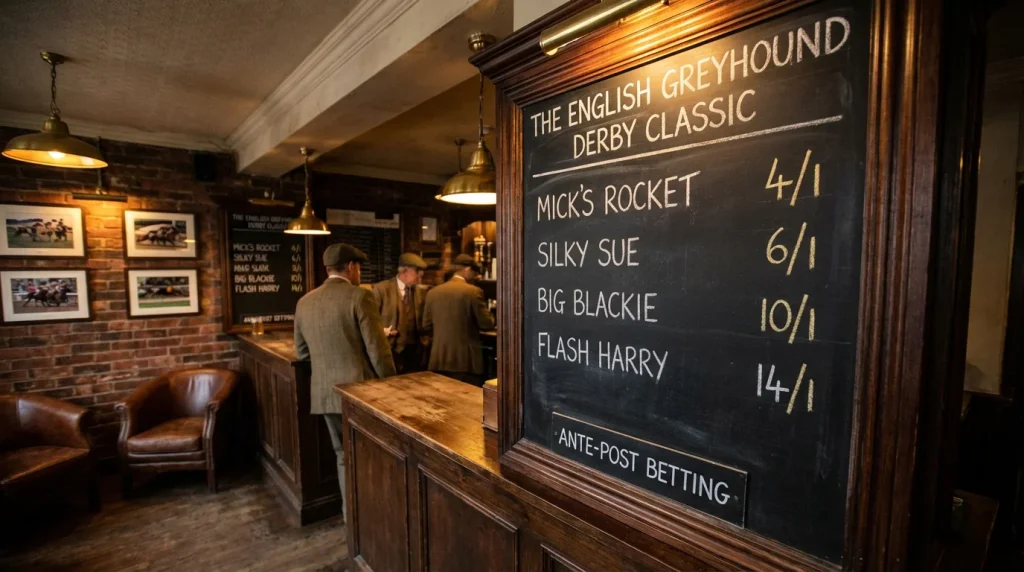
Ante-Post: Betting on Dogs Before They’re Even Entered
Ante-post greyhound betting is the art of backing a dog weeks before a race — knowing that if it doesn’t run, your stake is gone. It’s a bet on the future, placed when the market is at its widest and the uncertainty is at its highest. The prices reflect that uncertainty: ante-post odds are longer than race-day odds precisely because they carry risks that day-of-race bets do not.
In greyhound racing, ante-post markets are available almost exclusively on major events: the English Greyhound Derby, the St Leger, the Oaks, the Cesarewitch, and a handful of other Category One and Category Two competitions. You won’t find ante-post markets on a Tuesday BAGS card from Crayford. The bet type exists for the high-profile tournament events where dogs are known months in advance, where form can be assessed across a wider window, and where the prices are long enough to compensate for the non-runner risk that defines the market.
How Ante-Post Betting Works in Greyhound Racing
The mechanics of ante-post betting are straightforward, but the implications are often misunderstood by punters accustomed to standard race-day markets. When you place an ante-post bet, you back a dog at the quoted odds to win a specific future event. If the dog wins, you’re paid at those odds. If it loses, you lose your stake. So far, identical to any other bet.
The critical difference is what happens if the dog doesn’t run. In standard race-day betting, a non-runner triggers a refund of your stake or, in some markets, a rule-4 deduction. In ante-post, there is no refund. If your dog is withdrawn through injury, eliminated in an early round, or simply not entered by the trainer, your money is gone. You accepted that risk when you took the price, and the price was longer than it would otherwise have been because of it.
This no-refund principle is what makes ante-post prices attractive. The bookmaker is transferring the non-runner risk to you, and paying you for accepting it through wider odds. A dog that might be 5/1 on the night of a Derby final could be available at 12/1 or 16/1 in the ante-post market months earlier. The difference reflects the probability that the dog might not reach the final at all. Your job as an ante-post bettor is to assess whether that probability premium is large enough to justify the risk.
Major Ante-Post Greyhound Markets
The Derby, St Leger, Oaks and Irish Derby are the four races where ante-post markets open earliest and offer the widest prices. The English Greyhound Derby, as the flagship event, generates the deepest ante-post market — the most dogs priced, the widest range of odds, and the longest window of availability.
Derby ante-post markets typically open several months before the first round. Bookmakers price the leading contenders based on open-race form, trial performances, and trainer connections. The early prices are often generous because the field hasn’t been confirmed: dogs that look like contenders in March may not be entered in May, and the bookmaker builds that uncertainty into the odds.
The St Leger, traditionally the second most prestigious event in the calendar, runs over a longer distance and attracts a different profile of dog. Ante-post markets for the Leger are narrower — fewer dogs are priced — but the odds can be wider because the staying division has fewer obvious contenders and more uncertainty about which dogs will target the race.
The Oaks, for bitches only, and the Irish Derby, contested across the Irish Sea, both generate ante-post interest from specialist punters. The markets are thinner still, but the prices reflect that illiquidity: genuine overlay opportunities exist for punters with specific knowledge of the bitch or Irish racing populations.
Beyond the big four, selected Category One events like the Cesarewitch, the Laurels and the Television Trophy occasionally attract limited ante-post markets, usually from a smaller number of bookmakers. These niche markets can offer value precisely because they’re under-traded: fewer punters participate, bookmaker pricing is less sophisticated, and local knowledge of the likely entries creates an information edge.
Risk vs Reward: When Ante-Post Odds Justify the Gamble
Ante-post prices look generous because they include a built-in premium for non-runner risk. The question is whether that premium is big enough. Answering it requires a framework that accounts for both the dog’s chance of winning and its chance of actually reaching the race.
Start with your assessment of the dog’s winning probability if it reaches the final. Suppose you rate a Derby contender at a 15% chance of winning the final — roughly equivalent to 11/2 in odds terms. Then estimate the probability that the dog reaches the final: account for heat eliminations, potential injuries, and the possibility of withdrawal. Say you put that at 60%. The combined probability is 15% × 60% = 9%, which translates to roughly 10/1 in fair odds.
If the ante-post price is 16/1, you have a clear overlay: the bookmaker is offering 16/1 on a 10/1 true-price proposition. If the ante-post price is 8/1, you’re taking a price below the combined fair value — the non-runner risk isn’t being compensated. This multiplicative framework is crude, but it forces you to quantify the two separate risks (not winning and not running) rather than gut-feel your way to a decision.
The key variable is your estimate of the dog reaching the race. If you’re confident the dog is fit, well-targeted, and trained by a kennel with a track record of getting dogs to major finals, you can push that probability higher — perhaps 75% — which makes the ante-post price more attractive. If the dog has a history of injuries or the trainer has no record of targeting the specific event, the probability drops, and you need a wider price to justify the bet.
Timing Your Ante-Post Bets
The best ante-post value appears at the early stages — before trial results narrow the market. Once a dog starts winning heats or running impressive trial times, the bookmaker cuts the price and the overlay diminishes. The information advantage of ante-post betting sits in the window before the competition begins, when the market is pricing on general reputation rather than event-specific performance.
There is, however, a second window. After the early rounds of a tournament, a dog that qualified without producing a headline time may see its price drift slightly. If you believe the dog was nursed through the heat — running within itself to conserve energy for later rounds — the drift creates a re-entry point at better odds than the pre-competition price. This requires race-reading skill: distinguishing a mediocre performance from a deliberately restrained one is not always obvious.
The worst timing is immediately after a standout performance. A dog that wins a Derby heat by ten lengths will see its ante-post price halved overnight. The market overreacts to visual impressions, and backing the heat winner at the contracted price is rarely good value. Patience — waiting for the excitement to fade and the price to stabilise — is the ante-post punter’s most profitable habit.
The Patience Premium: Ante-Post as a Discipline
Ante-post greyhound betting rewards two things: knowledge of the dog and the nerve to wait while the field shrinks around you. It’s a bet type that suits the patient analyst — someone who watches the sport regularly, tracks the leading dogs through open-race campaigns, and forms opinions about their ability and trajectory before the bookmaker does. Impulse ante-post bets are just lottery tickets with worse odds. Considered ones, placed at the right time and the right price, are among the most rewarding bets in the greyhound calendar.