Each-Way Betting on Greyhounds
Best Greyhound Betting Sites – Bet on Greyhounds in 2026
Loading...
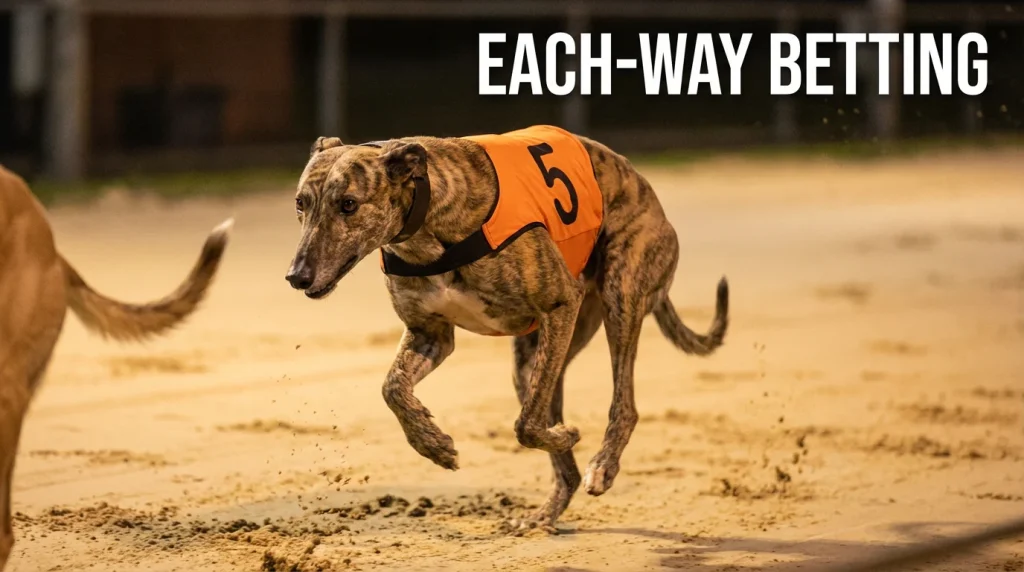
Each-Way on Dogs: The Comfortable Bet That Costs You
Each-way feels safe. In six-dog fields, it often isn’t. The each-way bet is the most popular comfort blanket in greyhound racing, and for plenty of punters, it’s also the most quietly expensive habit in their repertoire.
The logic sounds solid: back a dog to win and place, so even if it doesn’t cross the line first, you collect something for a second-place finish. It softens the blow, cushions the variance, makes the evening feel less brutal. The problem is that this comfort has a price, and in short-field racing — which is what greyhound racing is — that price is often too high to justify.
Each-way betting was designed for horse racing, where fields of twelve to twenty runners make a place bet genuinely useful. In a six-dog greyhound race, the dynamics are different. The field is small, the place terms are tight, and the odds at which each-way betting produces actual value are higher than most punters realise. Understanding where the break-even point sits — and being honest about how often you’re below it — is essential before committing to each-way as a regular approach.
How Each-Way Bets Work in Greyhound Racing
An each-way bet is two bets in one. Half your stake goes on the dog to win, and half goes on the dog to place (finish first or second). If you bet £5 each way, your total outlay is £10: £5 on the win and £5 on the place.
If your dog wins, you collect on both parts. The win bet pays at full odds and the place bet pays at a fraction of those odds, typically one quarter in greyhound racing. If the dog is 8/1, the win pays £40 (8 × £5) plus your £5 stake back, and the place pays £10 (8/4 = 2/1, so 2 × £5) plus your £5 stake. Total return: £60 from a £10 outlay.
If your dog finishes second, you lose the win half (£5 gone) and collect only the place portion. At 8/1 with quarter-odds place terms, the place returns £15 (£10 winnings + £5 stake). Your net result: £15 received minus £10 total stake = £5 profit. Not nothing, but considerably less than the £40 profit if the dog had won.
If the dog finishes third or worse, you lose both halves of the bet. There is no place payout for third in a standard six-runner greyhound race. This catches out punters who are used to horse racing, where three places are paid in larger fields. In dogs, it’s two places only, and the safety net is narrower than it appears.
Place Terms and the Fractional Odds Trap
The standard place terms for greyhound racing are one quarter of the win odds, with two places paid. These terms are set by the bookmaker and are consistent across the major UK firms for six-runner fields. Some bookmakers may offer enhanced place terms on selected races as a promotion, but the default is 1/4 odds for first or second.
The fractional odds trap becomes visible at shorter prices. Consider a dog priced at 2/1. The place portion pays at one quarter of 2/1, which is 1/2. A £5 place bet at 1/2 returns £7.50 (£2.50 winnings + £5 stake). Your total each-way outlay was £10. If the dog finishes second, you receive £7.50 — a net loss of £2.50. You’ve placed an each-way bet on a 2/1 shot and still lost money when it placed.
This is the mechanical reality that most casual each-way punters never calculate. At odds of 2/1, the place half of an each-way bet returns less than the total stake. The each-way bet only breaks even on a place result at a certain price threshold — and that threshold is higher than most people assume.
At 3/1, the place odds are 3/4. A £5 place bet returns £8.75 — still a loss against the £10 total outlay (net: -£1.25). At 4/1, the place odds become evens (4/4 = 1/1), and a £5 place bet returns £10 — exactly your total stake back. Break even. Below 4/1, each-way betting on a placed dog loses money. Above 4/1, it starts to generate a profit on place results.
The Break-Even Price for Each-Way Value
The mathematics are unambiguous. For each-way betting at 1/4 odds with two places, the break-even price on a place result is 4/1. Below that price, a dog finishing second returns less than your total stake. Above it, the place return exceeds your outlay.
| Win Odds | Place Odds (1/4) | Return on £10 E/W if Placed | Net Result |
|---|---|---|---|
| 2/1 | 1/2 | £7.50 | -£2.50 |
| 3/1 | 3/4 | £8.75 | -£1.25 |
| 4/1 | Evens | £10.00 | Break even |
| 5/1 | 5/4 | £11.25 | +£1.25 |
| 8/1 | 2/1 | £15.00 | +£5.00 |
| 10/1 | 5/2 | £17.50 | +£7.50 |
The table makes it clear. Each-way betting on anything shorter than 5/1 is, at best, a marginal proposition on the place component. At 2/1 or 3/1, the place portion actively loses money even when it “works.” This doesn’t mean you should never back shorter-priced dogs each-way — the win half still pays fully if the dog wins — but it does mean the each-way structure adds cost without meaningful protection at those prices.
The real value window for each-way greyhound betting sits at 5/1 and above. At those odds, the place return is profitable on its own terms, which means the each-way bet functions as intended: a genuine hedge that pays its way even on a second-place finish. Below 5/1, you’re better off either backing the dog win-only at the full price or not betting on it at all.
Scenarios Where Each-Way Genuinely Pays
Each-way betting earns its place in specific situations. The first is the outsider with a strong draw. A dog priced at 6/1 or longer because of recent form, but drawn perfectly for its running style, has a legitimate chance of placing without necessarily winning. If it’s a wide runner in trap 6 on a track that favours outside runners, the place probability may be higher than the market implies, and the each-way terms at that price return real money.
The second scenario is a competitive open race with no clear favourite. When the entire field is priced between 5/2 and 6/1, each-way on a mid-priced runner makes structural sense: the field is close enough that place probability is relatively high, and the odds are long enough for the place fraction to pay meaningfully.
The third is ante-post betting on major events. In tournament-format competitions like the English Greyhound Derby, early each-way prices on a dog you rate as a serious contender can offer substantial value. The place terms in ante-post markets for big races sometimes extend to three places, which changes the calculus further in the punter’s favour.
Outside these situations, the default should be win-only. It’s a less comfortable bet but a more honest one.
Clean Decisions: Win-Only vs Each-Way
The clearest way to decide between win-only and each-way is to ask one question: would I bet this dog to place at these odds if the win bet didn’t exist? If the answer is no — if the place odds aren’t attractive enough on their own — then the each-way bet is a compromise, not a strategy. You’re adding the place portion for emotional comfort, not for expected value.
Win-only forces clarity. You either believe the dog wins or you don’t. Each-way lets you hedge that belief, and hedging is sometimes wise — but in six-runner greyhound races, the hedging cost is high and the place probability is lower than in larger fields. Treat each-way as a precision instrument for specific conditions, not as a default setting for every bet you place. Your bankroll will notice the difference.