Greyhound Trap Draw Analysis
 Available in US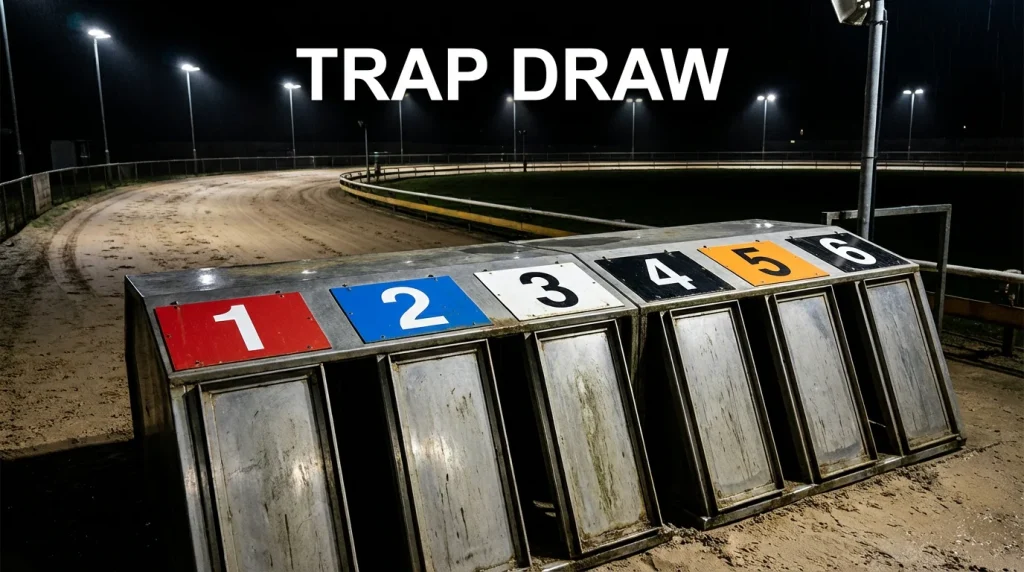
The Draw Decides More Races Than the Dog
In greyhound racing, talent without the right trap is just potential wasted at the first bend. The draw — the trap number from which a dog starts — is the single most underestimated factor in casual greyhound betting, and one of the most quantifiable edges available to any punter willing to study it.
Six traps, six coloured jackets, six dogs with different running styles and preferences. The racing office at each track seeds dogs into traps based on their natural running line: railers to the inside, wide runners to the outside, middle runners in between. When the seeding is correct, each dog gets the position that suits it. When it’s compromised — because the available dogs don’t distribute evenly across running styles, or because open races are drawn randomly — mismatches occur. Those mismatches are where betting value concentrates. Get more race analysis at dogracingbettinguk.
Understanding the trap draw is not an optional extra for greyhound punters. It is the starting point of every race assessment. Before you look at form figures, times, or trainer trends, the draw tells you which dogs have a structural advantage and which are fighting their own starting position from the moment the lids rise.
How Seeding Works in UK Greyhound Racing
Every dog registered with the Greyhound Board of Great Britain (GBGB) is categorised by running style. The three categories are railer (R), middle (M), and wide (W), and they describe where a dog naturally runs on the track — close to the inside rail, through the middle of the circuit, or towards the outside.
In graded racing, the track racing office assigns trap positions based on these categories. Railers go into traps 1 and 2, middles into traps 3 and 4, wides into traps 5 and 6. The notation appears on the racecard as a letter next to the trap number. A well-seeded race features two of each type: 1(R), 2(R), 3(M), 4(M), 5(W), 6(W). When this happens, each dog starts from its optimal position, early crowding is minimised, and the race is decided primarily by speed, stamina and form.
In practice, perfectly balanced seedings are uncommon. Railers outnumber wides in the UK greyhound population, and racing offices regularly have to place dogs in traps that don’t match their preferred running line. A railer drawn in trap 4 or 5 will attempt to cut across other dogs to reach the inside rail at the first bend, causing interference. A wide runner drawn in trap 1 will try to drift outward, potentially blocking the dog to its outside. These mismatch scenarios produce scrimmaging, checked runs, and finishing orders that have more to do with the draw than with the relative ability of the runners.
Open races — higher-grade competitions where the field is drawn randomly rather than seeded — amplify this effect. In an open race, a railer might end up in trap 6 and a wide runner in trap 1. The resulting chaos at the first bend is predictable only in its unpredictability. For the punter, open race draws demand particular attention: the form book becomes secondary to the starting positions, and dogs with favourable draws relative to their running style gain a disproportionate advantage.
Trap Bias by Track: What the Data Shows
Not all tracks treat all traps equally. The geometry of each circuit — specifically, the distance from the starting traps to the first bend and the tightness of that bend — creates measurable biases towards certain trap positions.
At tracks with a short run to the first bend, inside traps hold a structural advantage. The dog in trap 1 reaches the bend first on the shortest route, and if it leads into the turn, it can dictate the race. Romford is a classic example: a tight, two-bend track where trap 1 has historically produced a higher percentage of winners than any other position. At tracks like Towcester, where the run to the first bend is longer and the bends are more gradual, the trap bias is less pronounced and middle or outside runners have more time to find their position without being squeezed.
The data is publicly available. Several free and subscription-based services publish trap win statistics by track, updated weekly or monthly. A typical dataset might show that at a given track, trap 1 wins 22% of all races while trap 6 wins 12%. These aren’t small margins. Over hundreds of races, a ten-percentage-point gap between traps translates into a meaningful structural advantage that the market may not fully price in, especially on undercard races where less money flows through the market.
The caveat is that trap bias data must be interpreted in context. A track where trap 1 wins 22% of the time doesn’t mean every trap 1 runner is a good bet. The bias exists because that track suits railers, and railers are drawn in trap 1 by design. The useful insight comes from combining bias data with the specific runners in a given race: a railer in trap 1 at a track that favours inside runners is a dog with two structural advantages stacked in its favour. A wide runner in trap 1 at the same track has one advantage negated by one disadvantage — and the net position is neutral at best.
Identifying Draw Mismatches for Betting Value
The draw creates the most exploitable situations when a dog is in the wrong trap for its running style, or when the seeding leaves one runner with a clear path while others are lined up for trouble.
The first mismatch to look for is a sole wide runner in a race full of railers. If five of the six dogs in a race are classified as railers or middles, they will all gravitate towards the inside at the first bend. The single wide runner, typically drawn in trap 5 or 6, has the outside entirely to itself. While the inside pack scrimmages for rail position, the wide runner sweeps around the outside with clean air. This is the most common and most profitable draw-based angle in greyhound racing.
The second is a badly drawn favourite. When the shortest-priced dog in the race has a trap that contradicts its running style — a railer in trap 5, a wide runner in trap 2 — the market often fails to adjust the price sufficiently. Punters see the form, back the favourite, and ignore the draw. The result is a dog starting at shorter odds than its trap position warrants, which creates overlay value on its rivals. Opposing badly drawn favourites is one of the simplest and most effective strategies in greyhound betting.
The third is the complementary draw: two dogs with different running styles drawn in adjacent traps that allow both to run their natural line without interference. A railer in trap 1 and a wide runner in trap 2 present no conflict. A railer in trap 1 and another railer in trap 2 present significant conflict, because both want the same running line. The degree of potential interference between adjacent runners shapes the early dynamics of every race, and spotting it requires no more than a glance at the seeding and the trap draw.
Open Race Draws: Random and Dangerous
Open races, OR events, and invitation competitions are drawn randomly. No seeding applies. A railer can end up in any trap from 1 to 6, and so can a wide runner. The randomness of the draw makes open races the most volatile category in greyhound racing — and the most likely to produce unexpected results.
For the punter, open race draws should be assessed before anything else on the racecard. Check each dog’s running style against its trap position. Identify which dogs are well drawn and which face an immediate positional disadvantage. In a field where two dogs are equally strong on form but one is perfectly drawn and the other is fighting its trap, the drawn advantage is worth at least a couple of points on the betting scale. Markets often undervalue this because open race punters tend to focus on raw ability and recent times, not on the starting position.
The Draw-First Mindset
The most effective greyhound punters assess the draw before they assess the form. That sounds backwards — surely the dog’s ability matters more than where it starts? — but it reflects a practical reality. A dog’s ability is already priced into the market through its odds. What the market frequently misprices is the impact of the starting position on that ability. Also read our greyhound running styles.
Make the draw your first filter. Cross out dogs that are badly drawn for their style. Highlight dogs that have the trap in their favour. Then look at the form, the times, the grade. The draw won’t tell you who wins — but it will tell you who starts the race with an advantage before the lids even open. In a sport where the first bend decides the majority of outcomes, starting with an advantage is the closest thing to an edge you’ll find.
