Understanding Greyhound Racing Odds
 Available in US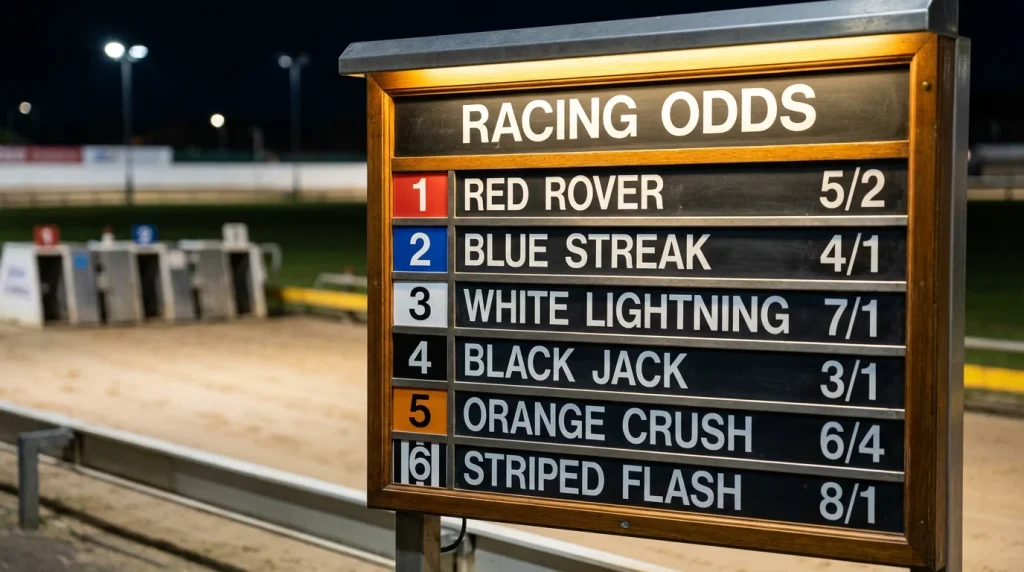
Odds Aren’t Predictions — They’re Prices
Greyhound odds don’t tell you who will win. They tell you what the market thinks — and the market is often wrong. This distinction is the foundation of any serious approach to betting on dogs. Odds are prices set by bookmakers and adjusted by supply and demand. They reflect the weight of money placed by other punters, the bookmaker’s own risk management, and a built-in profit margin. What they do not reflect, with any certainty, is the actual probability of a dog winning a race. Find more odds guides at dogracingbettinguk.
The gap between the market’s implied probability and the true probability is where every profitable bet lives. Understanding how greyhound odds are constructed, displayed, and manipulated in the minutes before a race is the first step towards spotting those gaps. Without that understanding, you’re accepting the market’s opinion as fact — and the market, in greyhound racing, is a blunt instrument shaped by casual punters, bookmaker overrounds, and very late liquidity.
Fractional vs Decimal Odds
UK greyhound racing traditionally uses fractional odds: 5/1, 7/2, 11/4, and so on. Most betting shops and on-course bookmakers still display prices this way, and it remains the default at many online sportsbooks for British customers.
Fractional odds express profit relative to stake. A price of 5/1 means you win £5 for every £1 staked, plus your stake returned. At 7/2, you win £7 for every £2 staked — or £3.50 per £1 unit. The format is intuitive for whole numbers but becomes awkward with more complex fractions. Is 11/8 better or worse than 6/4? Both equal 1.375 and 1.5 respectively, but the comparison takes a moment’s calculation in fractional form.
Decimal odds simplify the arithmetic. They show the total return per £1 staked, including your stake. A price of 6.0 in decimal is equivalent to 5/1 in fractional: you receive £6 back for every £1 placed (£5 profit + £1 stake). Decimal 4.5 equals 7/2. Decimal 2.375 equals 11/8. The advantage is immediate comparability: bigger number, bigger return. No mental division required.
The conversion between formats is straightforward. To convert fractional to decimal, divide the first number by the second and add 1. So 9/4 becomes (9 ÷ 4) + 1 = 3.25. To convert decimal to fractional, subtract 1 and express as a fraction: 3.25 – 1 = 2.25, which is 9/4. Most betting platforms allow you to toggle between formats in your settings, and using whichever you find more natural is fine — but if you intend to calculate implied probabilities or compare across bookmakers, decimal is the cleaner tool.
Starting Price vs Early Price: Which to Take
Greyhound markets behave differently from horse racing or football markets. Prices form late, move fast, and the starting price (SP) can differ significantly from the price available thirty minutes before the race. This creates a genuine tactical decision: take the early price or wait for the SP?
The early price is the odds available before the market fully forms. Some bookmakers offer prices on greyhound races from the morning or early afternoon, while others post odds only when the racecard is finalised. These early prices are set by the bookmaker’s traders based on form, draw and expected market interest. They can offer value if the trader has underestimated a dog’s chance, or they can represent a trap if the price is attractive specifically to encourage money on a dog the bookmaker expects to lose.
The starting price is the final odds at which bets are settled if no early price was taken. It’s determined at the moment the traps open and reflects the total weight of money across the market. In greyhound racing, SP formation is volatile. A dog might be 4/1 in the morning market and 5/2 at the off because heavy late money arrived. Alternatively, a morning 3/1 shot might drift to 5/1 by race time because punters didn’t back it.
The decision depends on your read and on the availability of Best Odds Guaranteed (BOG). If a bookmaker offers BOG on greyhounds, taking the early price is almost always correct: if the SP ends up higher than your price, you get paid at the better figure. If the SP is lower, your early price stands. BOG removes the downside of committing early and locks in any upside from market movement. Without BOG, the calculus is harder. If you believe a dog is being underpriced in the early market and expect money to come for it, take the price before it contracts. If you think the morning price is fair or slightly short, waiting can sometimes yield a better SP — but you’re gambling on market direction rather than race outcome.
Converting Odds to Implied Probability
Odds are just probability in disguise. Converting them to implied probability lets you compare the market’s assessment of a dog’s chance with your own — and that comparison is the basis of value betting.
The formula is simple. For decimal odds: implied probability = 1 ÷ decimal odds × 100. A dog at decimal 4.0 (3/1 fractional) has an implied probability of 25%. At decimal 2.0 (evens), it’s 50%. At 10.0 (9/1), it’s 10%.
In a fair market, the implied probabilities of all six dogs would sum to 100%. In reality, they sum to more — typically 115–125% in greyhound racing. This surplus is the overround, and it represents the bookmaker’s built-in margin. If you add up the implied probabilities of every dog in a race and the total is 120%, the extra 20% is the bookmaker’s edge. Every price in the market is slightly shorter than it should be, which means every implied probability is slightly inflated.
For the punter, the practical step is to compare your own probability estimate against the market’s implied figure. If you assess a dog’s true winning chance at 30% and the market prices it at an implied 20% (decimal 5.0, or 4/1), you have an overlay — a bet where the price exceeds the true probability. That’s a value bet. If the market implies 35% and you rate the dog at 30%, the price is too short and you should leave it alone.
This process doesn’t require mathematical precision. Experienced punters develop a feel for whether a dog is overpriced or underpriced relative to its form and draw. The implied probability framework simply formalises that instinct and gives you a consistent way to evaluate every potential bet against a clear standard.
Why Greyhound Odds Move So Much
If you’ve ever watched a greyhound market in the final five minutes before the off, you’ve seen prices shift by multiple points in seconds. A dog that was 5/1 can be 3/1 two minutes later, while a 3/1 shot drifts to 9/2 in the same window. The speed and scale of movement is noticeably higher than in most other sports.
Several factors drive this volatility. First, greyhound markets are thin. The total amount wagered on any single dog race is far smaller than on a horse race or football match. Small volumes mean that a single significant bet — even a few hundred pounds — can move the price sharply. When a well-informed punter or a kennel connection places a large bet in the last few minutes, the effect on the market is immediate and visible.
Second, greyhound information arrives late. A dog’s starting position, kennel condition and pre-race demeanour are factors that only become apparent close to race time. Trainers and track insiders who observe the dog in the paddock may act on that information in the final moments, creating sudden money that distorts the established prices.
Third, bookmakers actively manage their liabilities. If one dog attracts heavy support, the bookmaker shortens its price and lengthens rivals to balance the book. In a thin market, this adjustment happens rapidly, and the price movements can cascade: money flooding into one dog pushes others out, which may then attract contrarian bets, which pushes prices again.
For the bettor, this volatility is both a risk and an opportunity. The risk is that you take a price and watch it drift, meaning you could have got better odds by waiting. The opportunity is the reverse: when you spot value early and the market subsequently contracts, your early price becomes the best available. Monitoring late market moves also gives you information — a dog whose price shortens dramatically at the off is receiving support from somewhere, and that signal is worth noting even if you don’t act on it immediately. Also read our best odds guaranteed.
The Price Tells a Story — Learn to Read It
Every greyhound price encodes a narrative: what the market expects, where the money went, how confident the backers are. A dog drifting from 3/1 to 5/1 is telling you something — perhaps the kennel hasn’t backed it, perhaps the draw is worse than it looks, perhaps an insider knows the dog had a poor trial. A dog contracting from 7/1 to 4/1 is telling a different story: support, confidence, expectation.
Reading prices doesn’t mean following the money blindly. Late market support isn’t always right, and drifters win regularly. But price movement is one more piece of data in your analysis, and in a sport where every edge matters, ignoring it is a missed opportunity. The odds aren’t the truth — they’re the market’s best guess. Your job is to decide when that guess is wrong.
