Live, Virtual & Online Greyhound Betting: Platform Features That Matter
 Available in US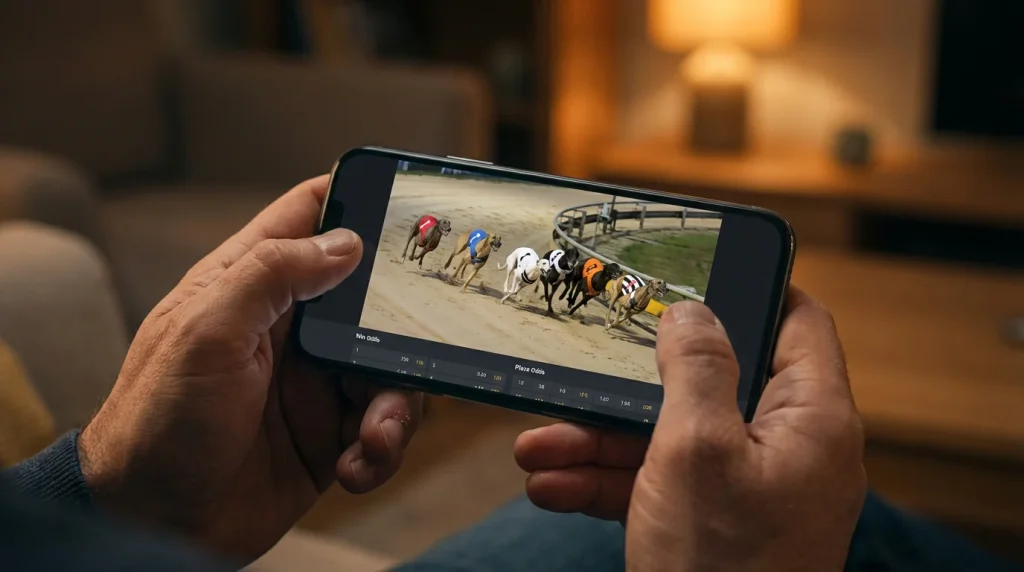
The Screen Is the Stadium Now
Most greyhound bets in the UK are placed on a phone screen, watching a dog run in real time via a bookmaker’s stream. The trackside experience migrated online — and brought new markets with it. A decade ago, betting on greyhounds meant either visiting the track or walking into a betting shop and watching a grainy satellite feed with eighteen-second delay. In 2026, the landscape has shifted entirely. Live streaming through bookmaker apps delivers every race in near-real-time to any device with a data connection. Virtual greyhound racing fills the gaps between live cards. Mobile betting apps allow you to study the racecard, watch the parade, and place your bet from the same screen without switching platforms. Find top betting platforms at dogracingbettinguk.
This shift in delivery has changed the economics and the behaviour of greyhound betting. More people bet on dogs now than when attendances at physical tracks were higher, precisely because the barrier to entry has collapsed. You don’t need to travel, queue, or even leave your sofa. That accessibility is a double-edged gift: it makes informed betting more convenient for the serious punter and impulsive betting dangerously easy for everyone else. The features available on modern betting platforms — live streams, form data, cash-out tools, virtual racing — are tools, and like all tools, their value depends entirely on how they’re used.
This guide examines the platform features that matter for greyhound punters in the UK, from live streaming quality to virtual racing mechanics to the data tools that can support genuine form analysis. The aim is to help you distinguish between features that improve your betting and features that simply encourage more of it.
Live Streaming Greyhound Racing
Free live streams from UK bookmakers turned greyhound betting from a niche into a daily habit for thousands of punters. The ability to watch a race as it happens — to see the trap break, the first-bend action, and the run to the line in real time — transforms the betting experience from an abstract numbers exercise into a visual one. And importantly for form students, watching races live or on replay provides information that the racecard cannot capture: how a dog moved in the parade, whether it showed anxiety in the traps, how it behaved at the first bend when pressure came from either side.
Who Streams What: SIS, RPGTV and Bookmaker Coverage
Live greyhound racing in the UK is distributed primarily through two providers: SIS (Sports Information Services) and RPGTV (Racing Post Greyhound TV). SIS holds the streaming rights for the majority of BAGS meetings and many evening cards, delivering the feed to licensed bookmakers who then make it available through their websites and apps. RPGTV provides additional coverage, particularly of feature meetings and higher-profile evening cards, and is available both through bookmaker platforms and as a standalone subscription service.
The coverage landscape means that not every bookmaker shows every race. The major operators — those with the broadest streaming licences — tend to offer the most comprehensive greyhound coverage, including BAGS, evening, and Saturday cards from most active tracks. Smaller or newer bookmakers may carry a reduced schedule. If comprehensive live streaming is important to your betting approach, and it should be if you take form analysis seriously, the breadth of streaming coverage is a legitimate factor in your choice of platform. A bookmaker that shows twelve tracks live is more useful to a greyhound punter than one that shows six, regardless of the sign-up offer.
Stream Quality, Delay and Betting Implications
Stream quality varies between platforms and between tracks. Most bookmaker streams deliver a functional picture — good enough to follow the race and see positioning, but not broadcast-quality. Camera angles are typically fixed, with a single overhead or side-on view that follows the field around the circuit. This is adequate for most purposes, though it can make it difficult to judge close finishes or to spot exactly what happened in a first-bend incident.
The more significant issue is stream delay. All bookmaker streams run on a delay relative to the live event — typically between one and five seconds, depending on the platform and the delivery infrastructure. This delay is deliberate: it prevents viewers from exploiting real-time information in in-play markets. For standard pre-race betting, the delay is irrelevant. For in-play betting, which is discussed in the next section, the delay is the primary reason why in-play greyhound betting is impractical for most punters. You’re watching something that has already happened, and the market has already adjusted.
In-Play Betting on Greyhound Racing
In-play greyhound betting exists, but the window is so narrow that its practical use cases are extremely limited. A standard greyhound race lasts approximately 30 seconds from traps to finish. The in-play market opens when the traps lift and closes when the first dog crosses the line. In that window, you’re watching a delayed stream, processing visual information, making a judgement, and attempting to place a bet — all within a timeframe that barely allows for a single decision, let alone a considered one.
Some bookmakers offer in-play greyhound markets, typically a simple win market that adjusts as the race unfolds. The odds shift based on the positions at key points — after the first bend, down the back straight, around the final turn. In theory, a punter who spots a dog running into trouble at the first bend could back the dog behind it at enhanced odds. In practice, the stream delay means you’re seeing an event that occurred seconds ago, and the in-play odds have already adjusted to reflect the actual position, not the one you’re watching. The latency between what you see and what has happened is the fundamental barrier that makes in-play greyhound betting a losing proposition for almost all punters.
The one scenario where in-play awareness has genuine value is post-race analysis rather than in-race betting. Watching how a race unfolds — which dogs had trouble, which ones ran freely, which ones faded — feeds directly into your form analysis for future races. You’re not betting in-play. You’re using the live picture to enhance your understanding of the form, which improves your pre-race betting on subsequent cards. Watching a dog get crowded at the first bend and checking back is infinitely more informative than reading “Crd1” in the comments column next week. The visual memory stays with you and colours your assessment the next time that dog appears on a card. That’s a more honest and more profitable use of the streaming technology than trying to beat a thirty-second market with a three-second delay.
Virtual Greyhound Racing: How It Works
Virtual greyhound racing is a random number generator dressed in animated dogs. Understanding what it isn’t is more useful than understanding what it is. Virtual greyhounds appear on the same bookmaker platforms as live racing, often occupying the schedule gaps between real meetings. The visual presentation mimics a real race — animated dogs running around a virtual track, with trap numbers, odds, and a finishing order. To a casual observer, it looks like a stylised version of the real thing. It is not.
RNG Mechanics and Virtual Odds
Virtual greyhound races are determined by a random number generator (RNG) — a software algorithm that produces a random outcome before the visual race even begins. The animated race you watch is a graphic representation of a result that has already been computed. The odds displayed for each virtual dog reflect the probabilities programmed into the RNG, not any assessment of form, draw, or ability, because the virtual dogs have no form, no draw preference, and no ability. They are lines of code assigned a probability distribution.
The odds on virtual greyhound races are structured to produce a fixed overround for the bookmaker — typically higher than the overround on real greyhound racing. A standard real greyhound market might carry a book of 115% to 125%. Virtual markets often run at 130% or higher, meaning the bookmaker’s built-in margin is larger and the punter’s expected return is correspondingly lower. The prices on virtual dogs are cosmetic: they tell you the probability the software has assigned to each animation, and nothing more. There is no way to gain an edge on a virtual greyhound race because there is no information to analyse. The outcome is random within the predefined probability structure.
Virtual vs Real: Why Form Doesn’t Apply
The critical distinction between virtual and real greyhound racing is that real racing produces exploitable information and virtual racing does not. In real racing, the form book records what happened — times, positions, comments, grade levels — and that historical data creates patterns that a skilled punter can identify and bet on. Virtual racing has no history. Each race is an independent event with no connection to any previous virtual race. The dog in Trap 1 that “won” the last virtual race has no greater or lesser chance of winning the next one, because it is not a dog. It is a randomly assigned number.
Punters who treat virtual greyhounds as a substitute for real greyhound betting when the live card is quiet are making a category error. Virtual racing is a pure gambling product — it offers entertainment and the thrill of watching an outcome unfold, but it offers zero opportunity for skill-based betting. Every bet on a virtual greyhound race faces the full force of the bookmaker’s overround with no analytical edge to offset it. For a punter who has spent time developing form-reading skills, draw analysis capabilities, and track knowledge, switching to virtual racing during a gap in the live schedule is like a chess player switching to a slot machine between tournaments. The shape of the game is familiar. The substance is entirely different.
Mobile Greyhound Betting: Apps and Features
The shift to mobile betting apps made greyhound wagering faster — and made reckless punting easier to fall into. The majority of online greyhound bets in the UK are now placed through mobile apps rather than desktop sites. The apps are fast, the interfaces are optimised for quick bet placement, and the live stream sits a tap away from the betslip. For a prepared punter who has already done the analysis, the mobile app is a convenient execution tool. For a punter who hasn’t done the analysis, the app is a frictionless route to placing bets on races they haven’t studied.
The best greyhound betting apps share several characteristics. They display the full racecard — form figures, times, trainer, weight, and recent race comments — within the app rather than requiring you to visit a separate form site. They integrate the live stream on the same page as the betting markets, so you can watch the parade and the race without leaving the bet interface. They offer quick-bet functionality for experienced punters who know exactly what they want, alongside a more detailed view for punters who prefer to study before committing. And they run a stable, low-latency stream that doesn’t buffer at critical moments.
The feature that matters most, though, is not technical — it’s the availability of form data. An app that shows trap numbers and odds but hides the form behind a link to an external site is designed for speed, not for informed betting. An app that surfaces the racecard, recent form, calculated times, and track statistics within the race view is designed for punters who want to make decisions based on information. The former encourages volume. The latter supports quality. Choose accordingly.
Features That Improve Your Greyhound Betting
Not all betting platforms treat greyhound racing equally. The features that matter go beyond live streaming. Some bookmakers invest heavily in their greyhound product — dedicated racecards, comprehensive form data, early prices on every meeting, and greyhound-specific promotions. Others treat dogs as a secondary product behind football and horse racing, offering bare-minimum coverage with limited form information and odds posted only close to the off. The difference in experience is substantial, and for a punter who takes greyhound betting seriously, the platform’s depth of greyhound coverage should be a primary selection criterion.
Best Odds Guaranteed and Cash Out on Dog Races
Best Odds Guaranteed (BOG) is one of the most valuable features a bookmaker can offer on greyhound racing. With BOG, if you take an early price and the starting price is higher, the bookmaker pays you at the higher price. This eliminates the timing dilemma that complicates greyhound betting: you no longer need to choose between locking in a price early (risking a better SP) or waiting for SP (risking a worse one). The catch is that BOG is not universally applied to greyhound racing. Some bookmakers offer it on all GBGB meetings. Others restrict it to evening cards or selected fixtures. A few don’t offer it on dogs at all. Check the terms before assuming you’re covered.
Cash out is the option to settle a bet before the event concludes, locking in a profit or cutting a loss at the bookmaker’s offered price. On greyhound singles, the cash-out window is narrow — the race is over in 30 seconds, so there’s little time to act in-play. The more practical application of cash out on greyhounds is with ante-post bets on major events like the English Greyhound Derby, where the market evolves over weeks and a dog’s price can shorten significantly between the opening book and the heats. Cashing out a 40/1 ante-post selection that has shortened to 8/1 after a strong heat performance is a legitimate strategic use of the feature. Using cash out to bail on a race-day bet because you’ve changed your mind is generally a sign that the bet shouldn’t have been placed.
Form Data, Stats and My Greyhounds Features
Some platforms offer integrated form tools that go beyond the basic racecard. These include detailed form histories extending beyond the standard six runs, calculated time comparisons, trap statistics by track, and trainer/kennel performance data. A few bookmakers and specialist services provide “My Greyhounds” or watchlist features that let you track specific dogs and receive alerts when they’re entered in upcoming races. For punters who specialise in a small number of tracks and follow individual dogs’ careers, the watchlist feature is genuinely useful — it flags opportunities without requiring you to manually check every card.
The quality of form data varies significantly between platforms. Some bookmakers display only the headline form figures and the morning price, which is barely more information than a betting shop screen provides. Others integrate data from Timeform or similar services, offering sectional times, performance ratings, and analytical commentary. The premium data isn’t always free — some platforms include it as standard while others offer it as a paid upgrade or through a linked subscription — but for a punter whose edge depends on form analysis, the cost of reliable data is an investment in the quality of your decisions, not an overhead.
Picking the Right Platform for Greyhound Betting
Choose based on coverage and data, not signup bonuses. The offer disappears after one bet — the platform stays. When evaluating a bookmaker for greyhound betting, the relevant criteria are specific to the sport: how many tracks does it stream live? Does it offer early prices on all meetings, including BAGS? Are the racecards detailed enough to support genuine form analysis? Does it offer BOG on dogs? Is there a watchlist or alert feature for tracking specific dogs? These are the questions that determine whether a platform supports serious greyhound betting or merely permits it.
The signup bonus is the least important factor. A matched-bet bonus worth £30 or a free bet on your first greyhound wager is a one-time incentive that vanishes after a single use. The platform’s greyhound infrastructure — its data, its streaming, its pricing depth — is what you’ll interact with on every subsequent bet for as long as you use the account. A platform with a generous welcome offer but shallow greyhound coverage will cost you more in missed information and poor odds over three months than the bonus saved on day one.
It’s also worth maintaining accounts with more than one bookmaker. Odds comparison across platforms is standard practice in horse racing and football betting, and it applies equally to greyhounds. A dog priced at 7/2 with one bookmaker and 4/1 with another represents a meaningful difference in expected return over hundreds of bets. Having two or three active accounts lets you take the best available price on each selection rather than accepting whatever your primary platform offers. Evaluate the product, not the promotion, and keep your options open.
Beyond the Screen: What No App Can Replace
Technology makes greyhound betting accessible. It doesn’t make it profitable. That part is still on you. The platforms, the streams, the form tools, the mobile apps — these are delivery mechanisms. They put the information and the markets in front of you faster and more conveniently than ever before. But none of them do the thinking. None of them read the form, assess the draw, check the grade, or decide whether the price represents value. That work is yours, and it’s the work that determines whether the technology serves you or merely entertains you. Also read our best odds guaranteed guide.
The best greyhound punters use technology as a tool within a broader process. They watch replays to refine their form assessments. They use form databases to compare calculated times across tracks. They set watchlist alerts for dogs they’ve identified as future value bets. They take early prices when BOG is available and SP when it isn’t. They ignore virtual racing entirely. They bet on races they’ve studied and close the app when the analysis doesn’t produce a bet. The platform is the instrument. The edge is the punter. That hierarchy doesn’t change regardless of how good the app is or how sharp the stream looks on a Saturday evening.
