
Greyhound Betting on Betfair Exchange
 Available in US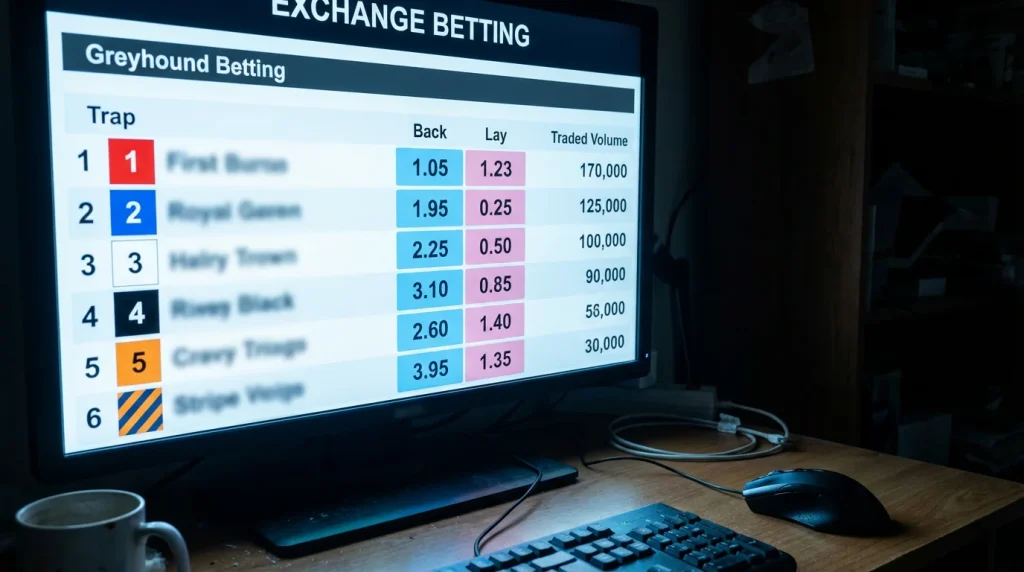
The Exchange Alternative: Betting Against Other Punters
On Betfair Exchange, you’re not betting against a bookmaker — you’re betting against other punters. That changes everything about how greyhound odds work. The bookmaker sets odds to guarantee a profit through overround. The exchange lets users set their own prices, and the odds that emerge reflect genuine supply and demand rather than a calculated margin. When a dog is 5/1 on the exchange, it’s because other punters are willing to lay it at that price, not because a trader has decided it should be 5/1. Find more exchange guides at dogracingbettinguk.
This peer-to-peer model creates several advantages: often better odds than the bookmaker, the ability to bet against dogs (lay), and access to pre-race and in-play trading. It also introduces challenges that don’t exist in traditional bookmaking: commission on winnings, variable liquidity, and the need to understand a different type of market mechanics. For the greyhound bettor, the exchange is a powerful additional tool — provided you understand when it serves you better than a bookmaker and when it doesn’t.
Backing and Laying Greyhounds on the Exchange
A back bet on Betfair works the same as a bet at a bookmaker: you select a dog, choose your stake, and if it wins, you collect at the quoted odds. The difference is that your bet is matched against another user who is willing to lay it — to accept your bet and pay out if the dog wins, in exchange for keeping your stake if it loses.
A lay bet is the opposite. You’re betting that a dog will not win. If the dog loses, you keep the backer’s stake (minus Betfair’s commission). If the dog wins, you pay the backer their winnings. Lay betting doesn’t exist at traditional bookmakers and is the exchange’s most distinctive feature. It lets you profit from dogs you believe are overrated, badly drawn, or poor value at their current price — something you can’t do with a standard bookmaker account.
Betfair charges commission on net winnings, currently starting at 6% for most users and potentially reducing with volume through their rewards programme. This means your effective odds are slightly worse than the displayed price. A dog showing 6.0 on the exchange pays a net 5.70 after 6% commission on a winning back bet. The commission is the exchange’s revenue model — they don’t need an overround because they earn from both sides of every matched bet.
The odds on Betfair are displayed in decimal format and move continuously as users place and cancel bets. Unlike a bookmaker’s fixed early price, exchange odds are dynamic: they reflect what the market is willing to offer at any given moment. Watching the exchange price in the minutes before a greyhound race gives you a real-time read on where the money is flowing — a dog whose price is contracting is attracting backing, while a dog whose price is drifting is losing support.
Exchange Odds vs Bookmaker Odds: When Betfair Wins
On popular races, Betfair’s odds regularly exceed the best bookmaker price. On thin markets, the opposite is true. Understanding when the exchange offers the better deal — and when the bookmaker does — is the key to using both efficiently.
The exchange tends to offer superior odds on well-traded events: evening meetings at major tracks, open races, and competition finals where the volume of bets is sufficient to produce tight markets. In these races, the absence of a bookmaker overround means the exchange prices are closer to true probability, and the bettor benefits from that accuracy. Comparing the best bookmaker price with the Betfair back price before placing a bet is a habit that costs nothing and captures value on every race where the exchange is better.
The bookmaker is better on thinly traded markets. BAGS afternoon races at smaller tracks may have minimal exchange liquidity — sometimes only a few hundred pounds matched across the entire field. In these markets, the back-lay spread widens, and the available price may be worse than the bookmaker’s early price. BOG at the bookmaker can also tip the balance: if the bookmaker offers Best Odds Guaranteed and the exchange doesn’t, the downside protection of BOG makes the bookmaker price more attractive even if it’s nominally lower.
Liquidity on Greyhound Markets: The Real Constraint
Greyhound markets on Betfair are thinner than horse racing. Big meetings have decent liquidity; BAGS afternoon cards often have almost none. This is the fundamental constraint of exchange greyhound betting, and it affects every aspect of the experience: the odds available, the stake you can place, the speed at which your bet is matched, and whether laying is even possible.
Liquidity concentrates in the final ten to fifteen minutes before a race. Earlier in the day, the exchange market for a specific greyhound race may show only a few hundred pounds of unmatched offers. As the off approaches, more users engage, the market deepens, and the back-lay spreads tighten. Placing your exchange bets close to race time maximises the chance of getting a good price and having your bet matched in full.
For the lay bettor, liquidity determines what’s possible. Laying a greyhound at a BAGS meeting where total market volume is £300 means your lay exposure is capped by the available money on the back side. If you want to lay a dog to a liability of £50 and only £20 of backing is available, your lay won’t be fully matched. On evening meetings at prominent tracks, lay liquidity is typically sufficient for moderate stakes, but large positions can still move the market.
Trading Greyhound Races: Pre-Race and In-Play
Trading greyhound markets — backing at one price and laying at a shorter price — works in theory. In practice, the speed of the markets makes it high-risk and low-frequency. Pre-race trading requires a dog’s price to move in your favour between your back and lay: you back at 8.0, the price shortens to 6.0, and you lay to lock in a profit. This works on events where market conditions shift — late money arriving, a withdrawn runner, or a significant piece of information — but on routine graded races, the price movements are often too small and too fast to trade profitably after commission.
In-play trading on greyhound races is even more constrained. The race duration — around 30 seconds — leaves almost no time for manual execution, and the stream delay puts screen-based traders at a disadvantage against those with faster data. Pre-race trading on major events, where the markets are deeper and the price movements more significant, is more viable than in-play, but it remains a specialist activity rather than a mainstream strategy. Also read our greyhound matched betting.
The Exchange as a Tool, Not a Magic Bullet
Betfair Exchange gives you an extra option, not an automatic edge. Use it when the odds justify it — not because it feels more sophisticated than a bookmaker. The exchange is better for well-traded evening races, for laying dogs you oppose, and for matched betting. The bookmaker is better for thinly traded markets, for BOG-eligible races, and for simplicity. The profitable greyhound bettor uses both, switching between them based on which offers the better deal on each individual bet. That flexibility, rather than loyalty to either platform, is the real advantage.
