How to Read a Greyhound Race Card
 Available in US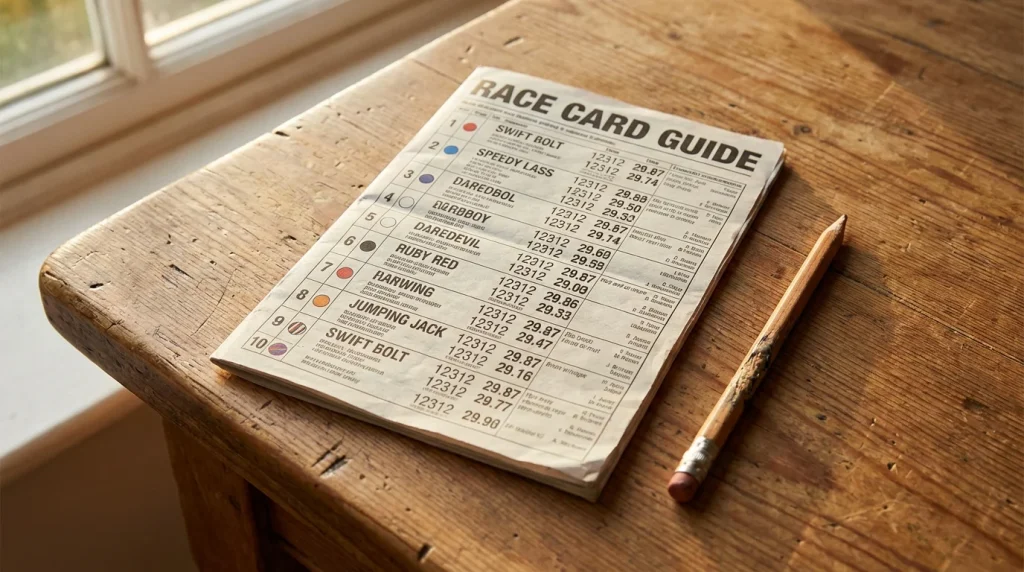
The Race Card Is Your Pre-Race Intelligence Report
Every greyhound race card compresses weeks of performance data into a few coded lines — and punters who can read them have a structural advantage over those who can’t. The racecard is the single most information-dense document in greyhound betting. It tells you what each dog did in its last six runs, how fast it ran, where it encountered trouble, what grade it competed at, and how its weight and season status compare to previous outings. All of this is encoded in a compact format that can be read in under a minute per dog, once you know what you’re looking at. Get more form guides at dogracingbettinguk.
Most casual punters glance at the racecard and focus on one thing: finishing positions. They back the dog with the most 1s and 2s in its recent form. That approach is better than nothing, but it ignores 80% of the useful information the card provides. The race comments, the times, the trap draws, the grade context — all of these tell a story that the finishing position alone cannot. Learning to read the full racecard is the single most impactful skill improvement any greyhound punter can make.
Standard Race Card Layout
A UK greyhound racecard follows a standard format, whether you’re reading it on a printed race programme at the track, in the Racing Post, or on a bookmaker’s website. The layout presents each dog’s information in a horizontal row, with the six runners listed in trap order from 1 to 6.
Each row typically contains: the trap number and jacket colour, the dog’s name, its trainer’s name and kennel location, its weight at the last weigh-in, the dog’s sex and colour, its date of birth, its sire and dam, its current grade, and its recent form — usually the last six runs, displayed as a sequence of columns showing date, track, distance, trap, finishing position, time, and race comments for each run.
The density of information can look intimidating at first glance. A racecard for a single race contains six rows of this data, and an evening card of twelve races presents 72 rows of compressed performance history. The key is not to read every column for every dog in every race. The key is to know which columns matter most and to read those efficiently — then drill deeper into specific dogs only when the initial scan reveals something worth investigating.
Decoding Form Figures
Form figures read left to right — most recent run last. A sequence like 1-2-6-3-2-1 tells a story of consistency interrupted. The dog won most recently, finished second the time before, then third, sixth, second, and first in earlier outings working backwards. Reading the sequence as a narrative rather than a set of isolated numbers is the first step to understanding what the form is telling you.
Finishing positions need context. A 1 at A3 grade is a different achievement from a 1 at A8. A 6 in a race where the dog was badly drawn and crowded at the first bend is less damning than a 6 in a race where it had every chance and was simply beaten on merit. The form figures alone don’t distinguish between these scenarios — you need the race comments and the grade column to interpret them properly.
Patterns in form figures are more useful than individual results. A dog showing 1-1-2-1-2-1 is a consistent performer winning more often than not. A dog showing 6-5-4-3-2-1 is improving steadily — each run better than the last. A dog showing 1-1-3-5-6-6 is declining, its best form receding into the past. These trajectories, visible at a glance in the form figures, tell you whether a dog is peaking, plateauing, or fading — and that trajectory is at least as important as the most recent single result.
The Times Column: What’s Meaningful and What’s Noise
A time of 29.30 means different things at different tracks. Without context, raw times are misleading. Every UK greyhound track has a different circumference, different bend geometry, different surface characteristics, and different timing equipment. A 29.30 at Romford’s tight 400-metre circuit is not comparable to a 29.30 at Nottingham’s wider 480-metre track — different distances, different layouts, different conditions.
This is why calculated times exist. A calculated time adjusts the raw clock time for track speed on the day, producing a standardised figure that allows cross-track comparisons. If the track was running fast (dry surface, no wind), the calculated time adjusts upward to reflect that the conditions flattered the time. If the track was slow (wet, heavy), the calculated time adjusts downward to account for the conditions. The result is a figure that more accurately reflects the dog’s true performance level, independent of external factors.
For the bettor, calculated times are more valuable than raw times for comparing dogs that have raced at different tracks or on different nights. They’re available on the Racing Post and through most data services. When you see two dogs in the same race with calculated times of 29.50 and 30.10, the half-second gap is meaningful — it reflects a genuine performance difference, not a track-speed artefact. Raw times, without adjustment, can flatter or diminish a dog’s performance in ways that lead to incorrect assessments.
Comments and Abbreviation Codes
SAw means slow away. Crd means crowded. Led1 means led at the first bend. These two-letter codes narrate the race in compressed form, and they’re the most underused section of the racecard. While most punters focus on the finishing position and the time, the race comments explain why a dog finished where it did — and that explanation is often more informative than the result itself.
Common abbreviations you’ll encounter on UK racecards include: EP (early pace — showed speed from the traps), SAw (slow away — missed the break), Crd (crowded — encountered interference), Bmp (bumped — physical contact with another dog), Led1/Led2/Led3 (led at first/second/third bend), RnOn (ran on — finished strongly), Fdd (faded — weakened in the closing stages), W (wide — ran a wide path), Rls (rails — ran on the inside), Ck (checked — had to slow or swerve to avoid trouble).
The value of these comments is in distinguishing between defeated dogs that ran below their ability due to circumstances and those that simply weren’t good enough. A dog that finished fourth but was recorded as “SAw, Crd1, RnOn” had a terrible start, was crowded at the first bend, and still managed to close on the leaders in the straight. That dog was almost certainly better than fourth-place form suggests, and its next run — from a clean break — may see a significantly improved performance. Conversely, a dog that finished fourth with the comment “EP, Led2, Fdd” had every chance: it broke well, led at the second bend, and simply couldn’t sustain the effort. That’s a genuine fourth-place run, and the comment confirms it.
Putting It Together: Reading a Real Race Card Entry
Consider a hypothetical racecard entry. Trap 3: Blue Flash, trained by J. Smith, 32.5kg, graded A4 at Romford, recent form 2-1-3-5-1-2. The last run shows: Romford, 400m, Trap 4, 2nd, 24.58, “EP, Led2, CkRnIn.” The run before: Romford, 400m, Trap 2, 1st, 24.41, “Led1, Aw.”
Reading this: the dog won two runs back from trap 2, leading at the first bend and winning unchallenged in a fast 24.41. Last time out, from trap 4, it showed early pace and led at the second bend but was checked and ran into trouble in the run-in, finishing second. The finishing position (2nd) looks fine, but the comment tells you the dog was interfered with late in the race and might have won without it. The time (24.58) was slower than its previous win, but the comment explains why.
Now the dog is in trap 3 for today’s race. Is it well drawn? As a dog that showed early pace in both recent runs, trap 3 gives it a reasonable path to the first bend if it breaks quickly. The grade is A4 — the same as its recent form — so it’s not stepping up into stronger company. The weight is consistent. The overall picture: a dog with recent winning form, excusable defeat last time, drawn reasonably well, at the right grade. That’s a runner worth serious consideration. Also explore our greyhound form guide.
Card Fluency: The Skill That Separates Punters From Gamblers
Reading a racecard takes five minutes per race. That investment is the difference between betting and guessing. The punter who can scan six dogs’ form, identify the key comments, compare the calculated times, and assess the draw dynamics has a tangible advantage over the punter who picks a name or backs the favourite. The racecard gives you everything you need. The only cost is the time to read it — and in a sport where you’re risking real money on the outcome, five minutes of preparation is the cheapest edge available.
