English Greyhound Derby Betting Guide
 Available in US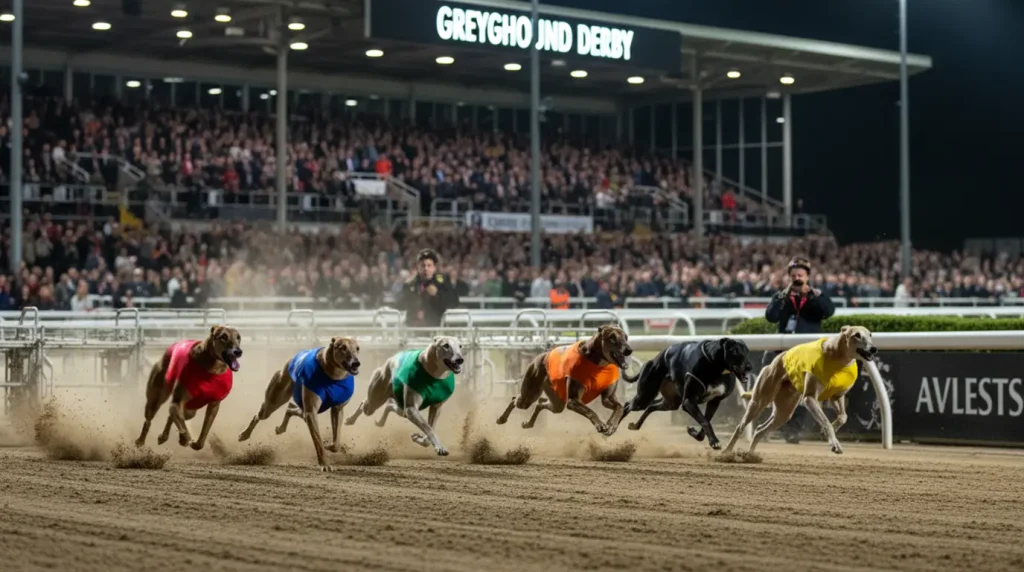
The Derby: Six Weeks of Knockout Drama
The English Greyhound Derby is the single biggest event in UK dog racing. It carries the richest purse, attracts the fastest dogs from across the country, and plays out over a six-week knockout format that systematically eliminates contenders until six remain for the final. For the bettor, the Derby is a different animal from standard graded racing. Ante-post markets open months in advance, the form landscape shifts with every round, and the final itself — one race, six dogs, no second chances — compresses all that preparation into thirty seconds of outcome. Find more race guides at dogracingbettinguk.
The Derby has been contested since 1927 and is currently held at Towcester, the Northamptonshire circuit that has hosted the race since 2021 after a history of venue moves — from White City (1927–1984) to Wimbledon (1985–2016), then Towcester (2017–2018), Nottingham (2019–2020), and back to Towcester. The competition’s prestige ensures that trainers target it with their best dogs, which means the quality of the fields is higher than virtually any other greyhound event in the calendar. Betting the Derby demands a different set of skills from everyday punting: patience for the ante-post market, tournament awareness across the rounds, and an understanding of what separates a Derby winner from a merely fast dog.
Tournament Format and Route to the Final
The Derby operates as a single-elimination tournament run over approximately six weeks. The early rounds begin with heats: groups of six dogs race over the Derby distance, and the top two finishers from each heat progress to the next round. The losers are eliminated. This structure repeats through quarter-finals and semi-finals until six dogs remain for the final.
The distance is 500 metres at Towcester — the standard four-bend trip on the circuit. Every round is run over the same distance and at the same track, which means the Derby rewards dogs that are consistent performers on that specific course rather than brilliant one-race specialists from elsewhere. A dog that qualifies comfortably through the early rounds, drawing well and avoiding trouble, accumulates Towcester-specific form that becomes increasingly valuable as the tournament progresses.
The knockout format introduces a dimension that standard racing doesn’t have: survival matters as much as speed. A dog that wins its heat by six lengths but picks up a minor muscle strain is worth less than a dog that qualifies in second place in perfect health. Trainers manage their dogs through the rounds with an eye on the final, sometimes accepting a slower heat time to keep the dog fresh. For the bettor, reading the intent behind a round performance — whether a dog was given a hard race or nursed through — is a skill that separates profitable Derby punters from those just following the stopwatch.
Ante-Post Derby Betting: Early Prices and Risks
The ante-post market for the Derby opens weeks before the first round, and for certain high-profile dogs, prices are available months in advance. These early odds reflect a combination of the dog’s known ability, its expected fitness for the competition, and the inherent risk that it might not reach the final — through injury, elimination, or withdrawal.
Ante-post Derby bets carry no refund for non-runners. If you back a dog at 10/1 before the heats begin and it gets eliminated in the first round, your stake is gone. If it’s withdrawn due to injury before the competition even starts, same result. This non-runner risk is priced into the odds: ante-post prices are wider than the equivalent prices would be on the night of the final, because the bookmaker is compensating you for taking on that risk. The question is always whether the premium is large enough.
The early rounds are where the biggest ante-post value sits. Before the heats, the market is at its most uncertain: bookmakers are pricing on form from other tracks, trial times, and trainer reputation, not on Towcester-specific Derby form. If you’ve done your homework — identified a dog with the speed, stamina and temperament for the Derby distance at Towcester, ideally with a trainer who has a history of targeting the competition — the early-round prices offer a value window that closes quickly once the dog starts winning heats.
Conversely, the worst time to bet ante-post is immediately after a dog wins a heat impressively. The market contracts sharply on heat winners, often overreacting to a single strong performance. If you missed the early price, waiting for a slight drift — perhaps after a less impressive quarter-final run — can offer a second entry point at better odds.
What Makes a Derby Winner
Not every fast greyhound is a Derby dog. The competition demands a specific combination of attributes, and understanding that profile is essential for ante-post and final-night betting alike.
Early pace matters, but it isn’t everything. The Derby distance at Towcester requires a dog that can break cleanly from the traps, hold a prominent position through the first two bends, and sustain its effort through the final straight. Pure sprinters who burn out after 300 metres don’t win Derbies. Neither do slow starters who rely on closing finishes — because in a field of six top-class dogs, the early positions are claimed quickly and the scrimmaging at the first bend is fierce. The Derby winner typically leads or sits second through the opening two bends and has enough stamina to maintain that position to the line.
Temperament under pressure is the underrated factor. The Derby final is run under floodlights in front of the biggest crowd of the greyhound year, with noise, atmosphere and pre-race tension that most dogs never experience. Some dogs thrive in it. Others, equally talented on standard race nights, underperform when the occasion overwhelms them. A dog that has run well in high-grade open races and televised events throughout its career has a proven track record under pressure. A dog stepping up from routine graded racing into its first Derby final is an unknown quantity, no matter how fast its times look.
Draw in the final is pivotal. The Derby final is drawn randomly — no seeding applies. A railer in trap 6 or a wide runner in trap 1 faces the same draw problems as in any open race, but amplified by the quality of the opposition. In a field of six elite dogs, recovering from a bad break or a crowded first bend is vastly harder than in a standard A2 race. The draw doesn’t just influence the result; it can override form entirely.
Notable Derby Winners and Trends
The Derby’s history is rich with patterns that inform modern betting. Certain trainers have targeted the competition with repeated success: kennels with multiple Derby winners across different dogs have demonstrated a systematic ability to prepare greyhounds specifically for the tournament’s demands. Backing a dog from a proven Derby kennel adds a layer of probability beyond raw form.
Recent decades have shown that the typical Derby winner is between two and three years old — young enough to be at peak physical condition but experienced enough to handle the tournament format. First-season dogs occasionally win, but more commonly, a Derby winner has at least six months of competitive racing behind it, with open-race experience at a high standard.
The favourites’ record in Derby finals is mixed. Market leaders win frequently enough that they can’t be dismissed, but they lose often enough to remind you that the draw, the break from the traps, and thirty seconds of unpredictable racing can override any amount of pre-race superiority. At the prices typically available on Derby night favourites — often 6/4 or shorter — the value question is acute. Backing a 6/4 shot that wins one in three finals is a losing long-term proposition. Finding the 5/1 or 7/1 shot that the market has underrated is where the money is.
Derby Night: One Race, No Margin for Error
The final distils everything. Six dogs, one race, the widest spread of outcomes possible in greyhound racing. Every ante-post bet, every round assessment, every draw calculation leads to this moment — and then the traps open and it’s over in half a minute. Also read our greyhound ante-post betting.
The smart approach to Derby night is to have formed your view in advance and committed to it. The final isn’t the time for impulse bets or last-minute changes of heart based on paddock appearance. If your ante-post selection has reached the final, you’ve already backed it at a better price than anything available on the night. If it hasn’t, assess the draw, identify the one or two dogs whose profile matches the Derby winner template, and bet accordingly — or don’t bet at all. There’s no shame in watching the biggest race of the greyhound year as a spectator rather than a punter. The Derby comes around every year. The only irrecoverable loss is a bankroll blown chasing one race.
